
Micromilspec Pilot GMT Dualtimer
Moving the Brand to a Higher Level
February 19, 2026
by Vincent Deschamps
Some of us are attracted to military watches because they represent the ultimate version of form-follows-function and less-is-more in horology. Historically, they were designed and engineered to fulfill specific roles, for the infantry, pilots, artillery crews, sailors, divers and paratroopers, so that they could both be able to read and measure time with precision and for the watches to endure some of the toughest conditions any mechanical timekeeping device has ever been put through. Field watches had dual-scale dials to show local and military time; pilot watches had large dials with large hour markers and even larger hands to be easy to read inside a tumbling cockpit; divers came with commensurate depth ratings, superlative night-time legibility, and dive-time bezel inserts to keep track of how long divers have been under. I’m writing in the past tense because nowadays most people in the military—as far as I know, as far as it’s said, and as far as I’ve been told—use digital and/or quartz watches.
These are cool but different and not as wowing in terms of engineering and design to yours truly.
The word on the street is also that battery-powered watches of any kind—smart or dumb ones—will soon be retired from the battlefield because it is now possible to track GPS-enabled timepieces and soon, as it seems, the barely audible pulse of a quartz caliber. So whether you are into mechanical military watches because they are “old school” or “the real deal” or because, if you are currently serving, soon you won’t be able to use a non-mechanical timepieces whilst on duty, then you’d be interested to know more about cogs-and-wheels professional-grade tool and military timekeeping devices such as the Micromilspec Pilot GMT Dualtimer which looks and is tough, legible, functional, and mission-ready wherever you are going and whatever you are doing. (For you a 6-month deployment in an undisclosed location; for me a trip to my local dumpster to get rid of my mountain of cardboard boxes.) Even though mechanical military watches have never gotten out-of-commission, they became scarcer for military personnel.

Specifications
That is of course when we’re speaking generally about the military even though prominent online magazines speak of special watches worn by those in uniform—limited edition Tudor Pelagos’ or military-issued Omega’s—which most members of the military cannot afford to buy. So on the one hand either they are those who wear a G-Shock or a Government-issued Submariner for special units, but for most, quartz-powered G10’s or their equivalent which retail for a couple hundred bucks or much less. Which is why we love speaking about brands such as Prevail which make tough and reliable analog watches accessible to active duty military and veterans alike. Anyway, there had to be something in-between a G-Shock and a Tudor which is why Micromilspec exists and released the Pilot GMT Dualtimer which is more attainable than the spectacular Milgraph we reviewed last year. Both are unique and excellent in their own way, though the Dualtimer is more in line with what a modern and robust mechanical military watch should and could be today.

As its name indicates, this model is a pilot watch with a GMT complication although it appears to be an aviation-themed timepiece more in name than in design, or at least we can say that Micromilspec doesn’t abide by the traditional design codes of pilot watches and created its own. Here, the review is complete! No, actually, because there is a lot that needs to be said about the specifications and design of this model. So let’s first chat about the GMT bezel which I know will upset a few watch nerds over here because it doesn’t follow the unofficial rules established by the Horological Wisdom: it comes with 120 clicks but rotates only in one direction, which is complete horror for some indeed as they expect for a GMT bezel to rotate in both directions. They would say so because it is easier to use this way to adjust the second time zone in a jiffy even though a jiffy is all you need to adjust a unidirectional bezel. Practically speaking, if you are a pilot working in a fighter jet or helicopter, a unidirectional bezel is more secure.

So it makes sense to have this kind of mechanism for this type of watch. What also makes sense is to have a lot of lume, here SuperLuminova X1 on the hands, hour markers, and all bezel markings so that reading the time where you are and at home is easy during the day and night. What makes further sense is to have a good depth rating because you never know what could happen to you or your watch, which is why the Pilot GMT Dualtimer has a healthy 200 meters of water resistance thanks to a screw-down crown and case-back. Moreover, a reliable and accurate caliber, the Sellita SW330-2 which beats at 4Hz, comes with 56 hours of power reserve, and is regulated to run at ± 7 seconds per day. Of course a sapphire crystal which we also find on the back which is impressive and cool to have for a 200-meter rated watch which comes with the following dimensions: 42mm in diameter, 50.3mm lug-to-lug, 12mm thick and 20mm lug width. 12mm is reasonably thin for a GMT timepiece with such a depth rating and a sandwich sapphire construction.

Design
Thus far we know that the world’s military have used many types of watches in the past many decades and that most use cheap ones but that fewer others sport much more expensive ones. Military timekeeping devices is a niche segment of the watch market in which timepieces can command $50 bucks to a couple hundred dollars to several thousands, including the aforementioned Tudor’s and Omega’s. But there are also brands such as Micromilspec which do issue watches to the military at a mid-range price. I’ve always been curious to know how the servicemen and women can afford to buy tool watches with costs more than say $500 USD, or if it is the Government that purchases them in large batches at a lower prices. We won’t answer this question today but that is a bit of food for thought. What is of interest here speaking about money is the fact that the Micromilspec Pilot GMT Dualtimer retails for $1,955 USD when it is in stock (more on that later) which is to me the limit at which a professional-grade and military-issued watch should retail for.

As always, I will be the first one to argue that singular designs generally command higher price tags because everything is custom made for the brand. And the more unique it becomes the more expensive it is to make which is in part why the Dualtimer retails for $1,955 USD and not half that. And we can find this bespokeness in all visual aspects of this model starting with the sharp and angular octogonal case which sits long and wide on the wrist but also flat, akin to the Lüm-Tec Eclipse E2. The case is designed akin to that of an integrated sports watch even though the strap or bracelet can be removed by way of non-quick-release spring-bars (again for safety.) It is mostly brushed save for polished chamfers which accentuate the angular aspect of it when looking at its lugs which slide off the case. The left side is vertical whilst the right side is complemented by boomrang-shaped metal protrusions which form subtle guards to protect the 6.4mm crown which is therefore partially recessed within the case. The crown is perfectly knurled as well.


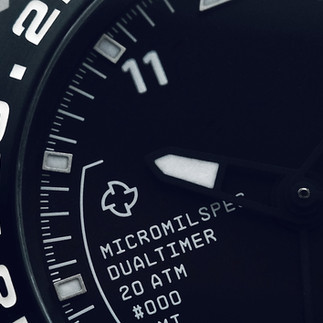
Before we leave the case I will make a quick mention of the bezel again, not because of the unidirectional nature of its construction but because of its design: the insert is blacked out so that the incised and lume-filled markings are easy to read. They are also printed in a large font which doesn’t match the hour markers on the dial which I believe was intentional to make the GMT functionality easy to read. So on the matte black dial we find small printed hour markers pushed to the edges of the applied rectangular and lumed elements and fully-graduated minute track, which opens up the dial whilst preserving its legibility. The bespoke Micromilspec handset, which we also saw on the Milgraph, is blacked out save for the lume applied in their center (and covering 40% of the seconds hand,) as they often are on pilot watches. Note the triangle + two dots at the twelve o’clock again a la pilot watch which reinforces Micromilspec’s take on the theme, and the larger-than-usual date aperture which lets us glance at three dates at once.




The Heart of the Matter
At the heart of the matter today is this: what on Earth is the Pilot GMT Dualtimer? It is actually many things at once which is what makes this model so interesting to me as an option for a military timekeeping device. On the one hand, it doesn’t look like any other pilot watch you and I have ever seen on the market which is something highly positive because novelty is a rare commodity nowadays. On the other hand the Dualtimer is a robust and fully spec’ed out tool watch which comes with good functionality, good lume, good water resistance, and good legibility. On yet another hand it is a $2,000 USD piece of horological equipment which not all watch-inclined members of the military will be able to afford but which is at the reach of more folks compared to a limited edition Tudor or Omega. (Whoever pays the bill.) I have nothing against the latter two brands but I find it silly to issue military watches which only high-ranking officers seem to be able afford to buy. Again, I’m about to veer off to another topic so I will stop.

Micromilspec is therefore a bit of a strange bird and I’m having difficulties wrapping my head around it. The brand runs many Governmental contracts and issues its watches in small batches, and each collection seems to be more original and better spec’ed than the previous one. Even though I made the claim several times in this article, directly or indirectly, that $2,000 USD is a lot to spend on a watch for many people, it isn’t that much to spend in fact for an original and robust tool watch which was designed and engineered to be actually used by professionals. On its website, Micromilspec indicates that the Pilot GMT Dualtimer pays homage to the brand’s first commissioned watch for the Royal Norwegian Air Force which is interesting as it puts Micromilspec, in my own little head, at the same level as long-established Swiss houses of watchmaking which have issued many watches for the military. I guess that is in fact the heart of the matter today: this relatively young brand makes government-worthy mechanical tool watches.

Conclusion
Phew, this was indeed yet another long review. I can’t help myself when I am writing about singular timepieces like the Micromilspec Pilot GMT Dualtimer. Sorry and not sorry at the same time. As we know, this model retails for $1,955 USD on the rubber strap as presented in this review and $2,035 USD on a stainless steel bracelet equipped with a butterfly clasp. It also comes in three other colors—Sand, Green, and Blue. The particularity of Micromilspec is that it manufactures watches to order, small orders to be precise as it is only making 75 of this model, and that it opens up orders only once a year for each collection, current or upcoming ones. So writing a review about this watch won’t lead you to be able to purchase one right away, but I hope it helped you become more familiar with the brand so that you won’t hesitate next time it drops a new ordering window.
Thanks for reading.


