

Profile
Nicholas Bowman-Scargill
It has become fashionable, or should we say normal, for anyone to revive a watch brand which went dormant many years prior, most likely during the infamous “Quartz Crisis” of the 1970s and early 1980s. Those who take this path have a certain passion for horology and decide to bring back to life a prestigious and sometimes obscure brand instead of creating their own. Why they do this will remain a mystery although one could suspect they do so because they aren’t particularly creative or because they have too much money and time on their hands or because they are particularly fond of that brand. More often than not, these entrepreneurs have no connection with the brand they are giving a new life to, sometimes a distant and questionable one, and in any case, they find intricate ways to infuse a certain legitimacy into their new horological endeavour. And again, more often than not, these new brand owners focus on reviving the collections which made the brand unique without ever planting one fresh tree in their brand-spanking new backyard.
More rarely—very rarely—a historical brand is resurrected or continued by an actual member of the founding family (and of the family which ran the brand from day one to the last day), as we saw recently with Mühle-Glashütte and a couple of years back with Circula, a scenario which is ideal. In this case, something magical happens, a perfect combination of tradition and modernity, of heritage and novel thinking, which permits the brand to cross from the past over to the present, and to establish a secure footing into the foreseeable future. And that is the type of scenario we’re about to discover by dissecting the life of Nicholas Bowman-Scargill, fourth Managing Director of Bristol-based Fears, a brand founded by his great great grandfather Edwin Fear in 1846, which unfortunately closed down in 1976, and disappeared for 39 years until Nicholas relaunched it in 2016 with a lot of motivation, a small war chest, and one collection. As we will see, today’s Fears navigates a fine and difficult line between honoring its formidable legacy and doing something new, a rather difficult task.

Nicholas Bowman-Scargill, fourth Managing Director
From Timex to Tag to Breitling
To this day we haven’t read a story of someone getting deep into watches who didn’t have either a connection to this world through a family member or who didn’t have an inclination for watches at a young age. Just like the world’s most iconic movie and musical stars dabbled into these forms of art very early on in their lives, those who take the widest leaps in horology have been enthralled by it since a young age indeed. For Nicholas it all started at age six when his parents gave him a tiny, white dial Timex for kids whose distinct feature was a pale blue rubber strap which indicated that it was powered by a quartz caliber whilst another version with a pale red strap indicated a mechanical-powered version of it. Back then (and I won’t mention which year it was even though it took place a few years after the ubiquitous Quartz Crisis,) quartz watches were the rage and constituted the latest and greatest in terms of horological technology. So Nicholas proudly wore his pale-blue strap Timex at school.
Four years later, therefore at age 10, he was given the opportunity to choose any watch from a store catalog and opted for a black plastic-cased Casio adorning a backlit white dial, chronograph functionality, and small LCD screen which displayed a variety of information. He wore it intensely for a few years and understood, in hindsight, that this Casio would inform his overall preference for light dials and what it meant to be passionate about something. After the Casio, Nicholas’ passion for watches did indeed grow and he started collecting all sorts of affordable fashion watches as many of us have done in the past. (During our “discovery” phase so to speak.) Design-wise, Nicholas was into art déco and fate brought him to stumble across an ad in the Financial Times suggesting that buying watches was a sound thing to do, and his eyes locked in on a Jaeger-LeCoultre Reverso. He asked his dad to find out how much the Reverso cost on his way to or from work, and he was blown away to learn that it retailed for 1,800£ (4,200£ today.)
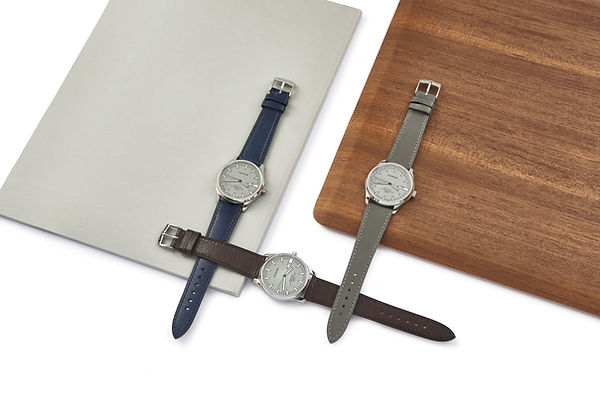
Redcliff 39.5 Date Pewter Gray
By the time he turned 16, Nicholas had had many attainable watches in his daily rotation and he felt it was about time to experience a different kind of horology. So he borrowed his father’s 150£ dressy quartz-powered Tissot, on which he discovered for the first time two little words printed at the six o’clock which would change the rest of his life for the better: “Swiss Made.” Nine letters which prompted Nicholas to embark on a long journey of self-education on Swiss horology, an adventure which took him to the doorstep of Tag HEUER. He set himself the goal of saving up for a quartz Aquaracer which cost around 500£, working week-end jobs whilst studying. And once he got close to his financial goal he wondered if he could push his budget to 700£ to purchase the mechanical version of the Aquaracer. After a while, he reached that goal and wondered once again if he could save up an extra 150£ to get a mid-sized quartz Omega Seamaster, a better watch and from a brand which came with a little more caché than the Tissot.
About two years after he borrowed his father’s Tissot, he capped his savings at 1,300£ and bought himself a Great White Omega Seamaster GMT whilst turning 18. Imagine young-adult Nicholas wearing his brand new Seamaster at school while most of his friends sported 20£-watches and that his father’s most expensive timekeeping device didn’t cost more than 200£. What this says to me is that Nicholas did indeed become passionate about horology and that his journey from the cheap plastic Casio to the stunning Seamaster says a lot about his motivation, focus, and drive to reach his goals. A theme we will meet again a few times later on in this article, along with the notion that Nicholas displays a great deal of patience when he knows what he wants, a character trait we are not all endowed with, alas. So Nicholas wore the Omega all the time and everywhere, to the point where one evening at a club the clasp broke, and being intent on not sliding the watch in his pocket to keep on dancing, he gaffer-taped it to his wrist.

Brunswick 38 Polar White

Nicholas speaking at HSNY
The first chapter of Nicholas’ path into watch collecting reached a pinnacle when, at age 22, he decided to buy himself a dressier timepiece and opted for a Ball Engineer with blued hands and an alligator strap. Looking at the main watches he had acquired until that moment, we can see that Nicholas did in fact acquire just a few pieces of different genres which he wore extensively, a recurring theme throughout his life regarding all sorts of objects and items he bought. Nicholas described himself as a one-watch type of person (spiritually) and as someone who only buys a few number of any type of things, but better things which he takes great care of, whether that be, indeed, watches or leather shoes. Not long ago he treated himself to a 43mm Breitling Avenger to mark a Fears milestone, a watch which many deemed too big for him but which he judged to be perfectly setting the tone whenever he hits the pub. Nicholas buys and wears watches which he can have experiences and build memories with, a philosophy which he infused into Fears.

Fears' boutique in Bristol
From University to Rolex
Although Nicholas was a de facto watch nerd by the time he legally became an adult, his plans were not to lead him into the professional side of horology—just yet. At university he studied pure economics as he intended on becoming an investment banker, an industry which came with a lot of allure as it had the image of easily creating new wealth for anyone who had enough drive and business acumen. In other words, big jobs that come with big bonuses. Believe or not, Nicholas wanted to become rich so that he could buy himself the best and most luxurious of watches. And so during his studies he did an internship at Deutsche Bank but alas, he graduated at the time of the 2008 economic collapse and he found himself not being able to hold onto any of his job prospects. So he went to look for another career and found a new opportunity doing PR in London where he moved from Bristol. Admitting that he has dyslexia (I do too,) he reckoned he had a hard time sitting in front of a computer all day and talking to people for hours on end on the phone.
So once again he decided he wanted to do something different, this time something that would involve some form of manual work. So over a cold Christmas in 2010, he shared with his family that he was considering a new career but he didn’t know what, and upon being asked what he had interests in, he answered trains and watches. So his two new career prospects involved either becoming a train conductor or doing something relating to horology. Luckily for us and the watch industry, he chose the latter and went on to draft the best cover letter he could write which he sent to all big watchmaking workshops in England. After a tedious seven month-period of interviews and two practical tests, Nicholas was hired by Rolex in 2011 to do an apprenticeship as a watchmaker in their London office. To celebrate this milestone, he bought himself a 1959, 34mm Rolex Oyster Date with a steel bracelet, silver dial, and smooth bezel, an excellent and appropriate choice for starting a career at Rolex.

Brunswick 38 "Orchid" and "Storm Grey"

Chronograph, Circa 1950
With this purchase and working at Rolex, he started to understand the power of brand recognition as he felt quite special sporting his vintage Oyster at the office and in everyday life—a steal of a watch he acquired for less than 1,000£—more so than he did wearing his Omega or Breitling . After working at Rolex for three years, he had saved up enough to buy himself a brand new white gold Day Date on a President bracelet and with a smooth bezel, with a staff discount of course. The stereotypical classic Swiss horological elegance which was perfectly fitting for his new career of a professional watchmaker trained by the best of the best. But one fateful day, a day which provoked another period of profound self-introspection, Nicholas met with a Rolex Pension adviser who jokingly said that he only had 39 years to go in order to benefit from a full Rolex retirement package, a thought that sent a shockwave throughout his body and mind, and stopped Nicholas in his tracks, frozen like a marble statue.
He became horrified at the idea that he would be spending the rest of his career in the same workshop repairing the same watches, so he felt estranged and dissatisfied. He met with family for lunch on a Sunday, as families often do, to share his concerns and told them what had happened meeting Rolex’s pension adviser. His new plan, he had decided, was to create his own company, an announcement he feared would be received with discontentment and criticism from his family as Nicholas had already changed ideas about his professional path a couple of times in the past. But…

Resurrecting Fears
…as Nicholas said, and as mothers often do, his mother casually inquired, whilst serving lunch, Why don’t you restart the family company? A few years back, when he was considering switching careers from doing PR to either becoming a train conductor or repairing watches, his mother had already casually said in passing that it would be funny if Nicholas were to become a watchmaker because his great grandfather and his father were watchmakers in Bristol. His mother didn’t provide more context to the comment, and Nicholas assumed that she meant watchmakers like he was about to become at Rolex. Little did he know that the aforementioned great grandfather and his father were the managing directors of the largest watch company West of England, employing at its peak one hundred watchmakers and producing hundreds of thousands of watches a year. The company they created and ran was founded in 1846 and was called Fears. During this family lunch, Nicholas had the greatest eureka moment as he decided he was going to resurrect the family brand.
The lunch took place in 2014 and Nicholas decided that 2016 would be the year he would officially re-launch Fears as it would mark the brand’s 170th anniversary. So he gave himself two years to write a business plan to revive Fears, a legacy brand full of outstanding and unique heritage, a reality which added a great amount of pressure onto Nicholas. During that time period, Nicholas searched for and found suppliers, and more importantly, raised money to fund the new brand. The Omega Great White Seamaster GMT became a printer and an office chair, the Ball Engineer became a filing cabinet, and all of his other watches turned into cash to purchase office equipment. Everything in his apartment that wasn’t nailed or screwed to the wall was sold on eBay and turned into cash as well. He and his husband also rented out their spare bedroom, and all of this formed a 35,000£ war chest he used to fund the creation of the first two-dial variant Swiss-made quartz collection he relaunched Fears with indeed in 2016.
The first time in 39 years that the name “Fears” appeared on a dial.

Sterling Silver Pocket Watch, Circa 1846

Edwin Fear, 1st Managing Director
One of the greatest difficulties Nicholas was faced with when he decided to resurrect the brand is the fact that it had been dormant for 39 years. Actually not dormant but gone completely. So all patents had lapsed, there was no archive, no leftover stock, no paper trail, which means that Nicholas had to display the ultimate form of resourcefulness and creativity in order to re-establish the family brand. And he wasn’t intent on taking the easy route often taken by folks who revive brands, which is to simply recreate vintage collections with modern dimensions and specifications, which would have been guaranteed to work as vintage was booming in 2016. Taking this path would have been akin to selling out his family’s name and legacy. Nicholas sees himself not only as the fourth Managing Director and sixth generation running Fears, but also as an employee of a company that will outlive him. So in each one of his decisions he asks himself what he would leave to the next MD, so he moves carefully but surely, with a “hand-break on” as he said.

Fears' 175th Party
His Collection-Building and Design Philosophy
Whenever Nicholas crafts a new collection, as he did for the first time in 2016, he aims at designing a watch that would be something Fears would have come up with should it had not shut down in 1976. So watches which are legitimate descendants of the brand, re-utilizing key design elements that made Fears what it was, scavenging old models to pick out unique hand, dial, and case designs, which formulated the brand’s unique aesthetic and nature which was, and still is again today, the perfect intersection of elegance and robustness. Nicholas indicated that Fears never made dress watches per se, nor did he ever make tool watches per se, but something that sits perfectly in-between. With the first collections he released in the first years of Fears 2.0, Nicholas designed watches which could be put side-by-side with vintage models and clearly belong to the same brand and are part of the same heritage. Not meager modern pastiches but contemporary watches which proudly bear the name “Fears” on the dial.
Nicholas also pointed out that many people like buying things from companies which have legacy, and he further pointed out that Fears was founded when Queen Victoria was in her 20s and one year after that GMT was standardized in the United Kingdom. So indeed the family company is an old brand and comes with indeed immense heritage which Nicholas strives to preserve each day whilst conversely infusing modern blood into it. He made an analogy in which Fears would be like the quiet but excellent restaurant down round the corner, which discreetly makes exceptional meals using exceptional ingredients, unlike the fancy restaurant which tries to reinvent the wheel each day and boasts about its accomplishments through fancy ad campaigns. As we know, Nicholas runs Fears with the hand-break on and what he does is to make good watches using good components, and watches anyone would deem as being good timekeeping devices should the brand name and logo be removed from the dial, and any sense of legacy and the idea of Fears be dissociated with it.

Circa 1930

Arnos Pewter Blue
In other words, Nicholas leads a two-headed horological project: on the one hand, to make modern watches which clearly come from the same lineage and which abides by the same design codes and ethics of quality; on the other hand, to push the boundaries of design to always be at the forefront of novelty and elegance, of robustness and mechanical prowess, through which the Fears legacy will live on. For example, Nicholas takes pride that the family brand is one of the rare ones to have a core collection, placing a bet on the fact that people would still be interested, and have an appreciation for, a Fears model a few years after it was released. In that same vein, Fears serializes all of its collections as it did before 1976, which means that any model can be traced back to a watchmaker, to a purchase, and be serviced decades after that it left the showroom. Fears both has an heritage division to service vintage models and a modern service division which repairs modern Fears.
In their stockroom, they have enough spare parts to repair any model for a period of 40 years.

Conclusion: the Second Stage of Fears 2.0
For the first years after having recreated Fears, Nicholas focused on releasing modern watches which drew inspiration from previous models so that they could clearly be Fears and evidently contemporary. Now he focuses on revisiting these models to give them a new character, a new meaning, as he feels comfortable expanding the brand’s core collections to something they had yet to become. As we age, he pointed out, we get a better grasp of who we are and we fine-tune our character, as he does with the brand. A good example of that is the Brunswick whose first iterations borrowed the cushion case and dial layouts of models from the 1940s and 50s, which now boast stone dials and jumping hour complications. Another good example is the recently released Arnos Pewter Blue which started from the Archives from the 1920s and 1930s, which Fears re-edited a few years back, and became a whole new thing with a dual-dial layout, hardened materials, and a cut-to-size rubber strap.
The latest example, which I will soon be reviewing for Mainspring, is the Redcliff 39.5 which was first the ubiquitous everyday sports watch and now the “ES” or “Endurance Specification” tough-as-nails elegant tool watch Navy SEALS would proudly sport on deployment. So it is clear where Fears started in 2016 and where it is now in 2025, and where it is headed in the years to come, first still under Nicholas’ leadership, and eventually under the leadership of someone else. But regardless of what happens in the future, it is amazing to see where Nicholas started in his horological career—from a Timex to an Omega to a Rolex and from working in finance to public relations to watchmaking—and where he is now—heading the largest and one of the oldest watch company in England, whilst remaining agile in bridging the past and present, and in being ruthless in his dedication to making excellent watches, but ones which elegantly fly under the radar.
As he said: “Fears should surprise people but not shock them.”
Thanks for reading.