
Arcange Selenograph CM02 Ice Blue
The Stuff Microbrands Don’t Play With
May 13, 2026
by Vincent Deschamps
Just a few days ago a good friend and I were discussing, as we often do, the state of the watch market. Many of our conversations are animated by passionate debates about trends, value, and specific brands or genres of watches we are both interested in. Friend asked me which country I believe makes the best overall watches in the microbrand sphere—the perfect mix of aesthetics, quality, and price—and I said Japan because I was thinking about Kuoe and Kiwame which output gorgeous watches which are superbly made for less than $1,000 USD. I of course asked him the same question and he answered France, as to him there are many brands in my home country which come up with interesting designs, good quality watches, at prices which are lower than they would be should these brands herald from another developed country. (Somewhere across the pond we reckoned.) And he’s right, and I failed to mention a watch I had on the docket to review this week which took me by many surprises to say the least.
This watch is the Arcange Selenograph CM02 Ice Blue which is short of being the most extraordinary timepiece I’ve ever seen for under a grand— 571€/$670 USD to be exact when launching on Kickstarter on May 29, 2026, and 845€/$922 USD full retail thereafter. Both on account of the way it looks as it is endowed with the majestic allure of some of the most complex and refined watches mankind has ever come up with, and on account of the engineering that went into the case to symbiotically complement its appearance. Selenography is the study of the surface and physical features of the Moon and the collection’s name stems from the true moon phase complication it comes with, in addition to being a triple-calendar timepiece which displays the date, day of the week and month of the year. All of these features and complications inhabit a slender 38.5mm stainless steel case whose superb design is answered by the ultra elegance and classicism of the dial. I told you it has taken me by surprise.
The Selenograph isn’t supposed to be my type of watch but I’ve been wowed by its beauty.

Specifications
We don’t often see triple calendar watches anywhere in the watch world let alone in the tiny corner of microbrand horology. Perhaps because they are seen as being absolutely obsolete since the rectangular devices we carry everywhere with us do all of this and more accurately than any mechanical watch ever has and ever could. But since we do like to wear watches and knowing that there are humans out there who do use them to know the time and sometimes the date, it would make sense that once in a while a couple of brands would come up with a triple calendar timepiece. The last and one of the few I reviewed is the Swedish Maen Brooklyn 36 which I would like to own one day, another one is the French Depancel F-Back Dusk Blue which came in a more sporty configuration, both equipped with mechanical movements, however both deprived of a moon phase complication which makes the Arcange Selenograph rather special. (The brand owner claims his creation is the only one of its kind under $1,000 USD on the market today.)

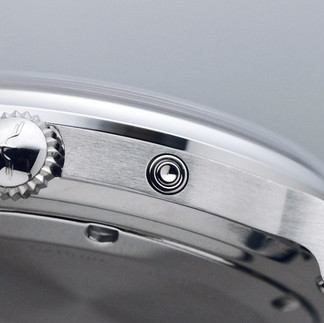
I do tend to naturally trust people, perhaps to a fault, and regardless of the veracity of this statement, the Selenograph is quite something. Its multitude of complications are powered by the combination of a trusty Japanese made Miyota 9015 (4Hz/42 hours of power reserve) which is a popular movement for brands small and not so small, to which was added a 1.6mm thick module which animates the triple calendar and moon phase functionalities. (Its thickness will matter in a second.) Below the twelve o’clock we find two apertures which indicate the day of the week on the left and month of the year on the right, set by two pushers built-into the case, on the northwest and northeast corners of it respectively, a pointer date complication which is itself set by way of another pusher on the lower east side of the case, and lastly a fourth pusher on the southwest corner which sets the moon phase located at the six o’clock on the dial. The latter is a proper moon phase which follows the actual 29.5-day moon cycle.

That’s a lot of functionality built into one timekeeping device which won’t remove more than $922 USD from your bank account on the most expensive side of the spectrum. Arcange managed to fit all of this into a nimble case which measures 38.5mm in diameter, 45,5mm lug-to-lug, 11.50mm thick (including the crystal,) and comes with a 18mm lug width. 11.50mm is thin given the Miyota 9015 + custom module as this is the height many watches which are deprived of so many complications come with. As you could rightfully expect, the Selenograph has a 50 meter depth rating which is more than decent for this type of watch, and proudly displays a box-styled double-domed sapphire crystal equipped with five layers of inner anti-reflective coating, and a 6mm semi-recessed crown endowed with superb knurling. The watch ships on a full-grain calf leather strap equipped with quick-release spring-bars and a finely CNC machined buckle. Again I would invite you to keep in mind the price at which Arcange sells the Selenograph.

Design
The more time passes and the more watches I review, the easier it is for me to understand that any watch can be my kind of watch (and yours as well) as long as I find the right example of it. I’ve rambled about this idea a few times before when speaking about my newfound love for mechanical chronographs when sporting the Maen Skymaster 38 MKIII.MCT M6.2.1, or the discovery of a new passion for dressier timepieces through the Anders & Co AC2 Volcán Ice Blue (and perhaps I have a thing for this particular colorway.) Well, today I realized that I may have a thing for ultra classic and elegant multi-complications timepieces since I’m feeling strong stuff looking at the Selenograph comfortably resting on my wrist as I’m typing these many words into the horological ether. I know how this sounds: the Selenograph is a niche type of watch and one which I wouldn’t have even looked at before should it had not come in such a glorious package. For we must find the right version of something for it to become our thing is what I believe.

However, and contrary to what you may or may not believe, it isn’t this watch’s complication and bespoke module which I find to be its most interesting features, but rather its dropdead gorgeous case and dial. It’s one thing to find a way to fit a triple calendar + moon phase movement inside a slender 38.5mm case, but it’s a whole other ordeal to find a way to do it so elegantly. Because when I first saw the Arcange Selenograph I first saw its case, which may or may not remind me of a 1950s steel body I may or may not have seen at some point in my four-decade existance—I’m not trying to be coy about what this might be, I genuinely don’t remember as I’m not a vintage horological expert. Anyway, the case of the Selenograph is superb and infused with an ultra classic aesthetic which we rarely see microbrands play with: something of a lug-less case with lugs, displaying a perfectly rounded profile and small rounded lugs which flare out as if to counter the roundness of the steel body. It flows so elegantly on the wrist.

What microbrands are becoming increasingly good at is finishing. They not only find ways to make finely finished cases but to offer them at ridiculously low prices compared to what mainstream brands are asking for for a lesser quality job. And the icing on the cake (to me) is when brands opt for the right type of finishing to highlight certain parts of the cases in effective ways: for example the Selenograph showcases a rough industrial horizontal brushing on the mid-case which accentuates the intense angle with which the lugs flare out from it, and mirror-polished surfaces on the sloped fixed bezel which puts the emphasis on the roundness of the case. Or even polished chamfers located on the belly of the case to narrow its vertical presence on the wrist. Arcange surely complicated its existence by over-thinking the case finishing of the Selenograph and we stand to benefit from it. I do further appreciate the finely polished upper lugs surfaces which slims them down and the four polished pushers which add a last touch of contrast.




And since there are many things we ought to look at on the dial it had to be drop-dead gorgeous as well. First, a vertical CNC-machined wave pattern sets the tone of elegance for our exploration of it, framed by a railroad minute track printed in a light color, itself flanked by a double-lined dark blue ring on which are printed the 31 dates of the month in gray. Moving back inward we find polished applied hour markers highlighted with Arabic numerals at the cardinal points, and teeth-shaped ones everywhere else. Above the six we find a classically styled moon phase with shimmering silver accents, the brand’s name stamped above it, and further above the pinion the two framed apertures indicating the day of the week and month of the year printed in black on white discs. And then there are the hands: two fully polished leaf hands for the hour and minutes, and a long polished one for the pointer date complication finished with a crescent-shaped blue tip. Arcange even bothered putting a polished cap on the pinion!


The Heart of the Matter
You know the far-fetched sentence many journalists and content creators use, the “this watch looks like a million bucks”? Well I hate to use it but it is more than appropriate to do so today studying the Arcange Selenograph CM02 Ice Blue under the microscope. It doesn’t look like a watch which retails for less than $1,000 USD, not only on account of the type of information it displays—and subsequently the technology it is equipped with—which remind me of ultra rare Vacheron Constantin’s we see in history books or in museums, or the classic layout and design of the dial which also makes me think of these ultra rare VCs, or even the superb case and its flared lugs which, well, also make me think of the above brand. Again, it is one thing to go for a certain aesthetic—which Arcange did superbly well and with a bold attitude—but it is another shebang to do it so well and to make it available at this price point, should we even bother discussing value today. Because everywhere you look there is something superbly done to be observed and taken in.

Conclusion
To use another popular catchphrase: I cannot think of any other watch which comes close to the Selenograph today in terms of design and quality and that says a lot about not only the state of microbrands today but also, as my friend pointed out, French brands which strive to create interesting horology and thrive in reviving a certain classic and timeless aesthetic. Well, now I’ve become a big fan of a type of watches which I never thought I would have an interest in and that is thanks to Arcange’s impeccable attention to detail and thoughtfulness in design and execution. So please know that the Selenograph is launching May 29, 2026, on Kickstarter for the discounted price of 571€/$670 USD, which you can order through June 6, 2026. Full retail afterwards will be 845€/$922 USD and the Selenograph comes in five versions: CM01 Classic with a cream dial; CM02 Ice Blue; CM03 Eclipse with a black dial; CM04 Syros Blue with a two-tone blue dial; and CM05 Salmon.
Thanks for reading.


