
Benrus Type 2 MIL-SPEC
Same Soul, Better Specs, But…
December 16, 2025
by Vincent Deschamps
Why are we about to embark on a long review of a vintage military watch re-issue? What is so special about it that hundreds and even thousands of words are going to be woven together to tell a story about it? Wouldn’t it make more sense, and be a better use of our time, to do an exposé on the latest Swiss sports watch or the new Frankenstein-like invention of that eccentric watchmaker? The reason why I bother reviewing vintage-inspired and modern military watches is because of what they represented yesterday and what they still represent today: the immaculate definition of a highly purpose-driven tool. Even though a mechanical watch is made of hundreds of components, each was engineered and manufactured to serve a single-purpose, and once a component was added to another, and together they are all linked to give the tool its purpose. In the case of military watches, the purpose is to tell the time simply and directly whilst being able to withstand the harshest of environments.
Moreover, mechanical analog tool and military watches are as human as they can be, in the sense that they are physical and not digital, vulnerable to showing wear and tear in ways electronic devices can’t. In other words, every component it is made of ages, slows down, wears out and needs to be repaired and maintained like our bodies do. For those who care about wristworn mechanical timekeeping devices, things don’t get as straightforward as a military tool watch. Thus today we’re going to explore the world of U.S. Military-issued dive watches by taking a close look at the re-issued Benrus Type 2 MIL-SPEC, originally manufactured between 1972 and 1980 following MIL-W-50717 which called for a legible, robust, and discreet dive watch to be worn by members of its various special forces (e.g., Navy SEALs, Army Rangers, UDT Divers.) The Type 2 was made along with the Type 1 and its particularity is its superlative legibility and strong build. It was/is a tool in its purest form.

Specifications
As we will later see, the Type 2 of 2025 is visually identical to the one from the 1970s. I’m glad Benrus decided to preserve the singularity and iconic design of the OG whilst it also offers a novel and very much modern interpretation of it with a bronze case, fumé green dial, date aperture and a traditional dive-time bezel called the Type 2 UJ. What has changed in the past 50 years however for the Type 2 MIL-SPEC is the components it is made out of as it is always the case with re-editions and re-interpretations of vintage models. Back in the 1970s the Type 2 was made of a monobloc case which meant the movement was front-loaded and there was no removable case-back. It was designed so because back then gaskets weren’t as effective as they are today keeping water away from the inner workings of a mechanical watch and thus Benrus (and other brands) wanted to remove as many failure points as possible. This made the original Type 2 water resistance to 1,200 feet (365 meters) which was really good for the time.

The depth rating was one of the requirements from MIL-W-50717 along with good nighttime legibility which was insured by radioactive materials in the 1970s and with BGW9 SuperLuminova today, generously applied on the hands, printed hour markers (and triangles,) and all bezel markings. The bezel is bi-directional and friction-fitted like the original, here the insert is made of matte coated aluminum for long-term durability whilst it appeared glossy on yesteryear’s iterations. Moreover, the crystal was made of hesalite back then as it was known to resist shocks quite well whilst it is a double-domed sapphire today which Benrus complemented with double-sided anti-reflective coating to ensure good daytime legibility. (Domed sapphire crystals tend to reflect the faintest of light rays akin to a giant mirror in the desert.) What is interesting already is that Benrus privileged the scratch-resistance of sapphire instead of the shock-resistance of hesalite which indicates that the use-case scenarios for the modern Type 2 have changed.

The monobloc case construction was swapped for a traditional screw-down case-back which together with the screw-down crown ensures the same 1,200 feet/365m of water resistance (and probably more). Benrus indicates on its website that the case measures 39.5mm in diameter but it actually clocks in at 42.2mm from the nine o’clock to the three o’clock at the widest point of the asymmetrical case, and therefore has the same diameter as the original. The lug-to-lug is 47.66mm, the thickness 14.40mm, and lug width 20mm, but I do not know how these compare to the originals. The unsigned crown measures 6.5mm in diameter and is complemented by deep knurling which makes it easy to grab and operate to wind the and set the ETA 2892 caliber inside (4Hz/42 hours of power reserve.) From what I know, the vintage Type 2’s were equipped with a modified ETA 2620 caliber which beat at 3Hz and had 42 hours of power reserve, which Benrus called a GS1D2. I wasn’t lying when I said that what mostly differentiates the old from the new is the tech.

Design
There isn’t anything new really to report on the design front for the modern Benrus Type 2 MIL-SPEC as it compares to the old one. But that is exactly what makes this model so fascinating for folks who adore the superlative visual straightforwardness of military tool watches. As mentioned in the introduction, they are the epitome of the purpose-driven wristworn timekeeping devices which were designed with a specific purpose in mind which can’t be said of the majority of watches designed outside of the military and utilitarian-oriented domains. Say what you must of, for example, a Rolex Submariner’s Mercedes handset and hour markers combo, it didn’t make for the easiest watches to read compared to the dual stack of Arabic numerals we find on the Type 2 MIL-SPEC. (I could have opted to review the Type 1 but it leaned too much into the classic genre of dive watches which isn’t as visually compelling for a tool watch as the Type 2.) The Type 2 by the way was added to the Type 1 for field operatives who required the most legible of dials.

Practically speaking, the dial of the Type 2 is that of a field watch mounted inside the case of a robust dive watch. The local time is indicated by large Arabic numerals made of thick layers of luminescent compound and framed by thin white lines, matched to large reinforced multipartite pencil-style hour and minute hands filled with BGW9 and finished in a matte white paint. The hands and hour markers contrast superbly with the matte black dial which accounts for the aforementioned superlative legibility, so does the 24-hour military scale printed in the same wide typeface as the local hour markers which makes it easy to see at a distance. (Akin to what we saw on the DTU-2A/P.) As we see on field watches too, our eyes are more effectively drawn to seeing the hour markers for they are buttressed by inner-facing triangles which Benrus also lumed. Whether one would be gazing at (or using for operators) the dial of the Type 2 MIL-SPEC during diurnal or nocturnal activities, one wouldn’t struggle to know what time it is.


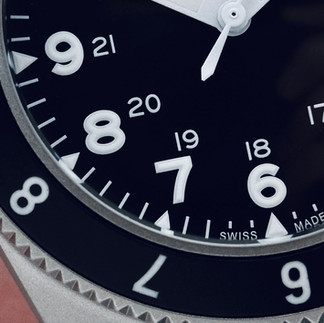


When it comes to the case, Benrus preserved 95% of the original design and took a few liberties for the remaining 5%. The overall shape of the case is the same. There is the same asymmetry which made the original so cool, where the right side protrudes out to form integrated crown-guards, a design feature which ensures the crown would be protected whilst keeping the watch comfortable to wear. There are the same straight-cut spaces in-between the angular lugs, but the latter are cut down at an angle on the modern version whilst they were faceted on the original. Benrus also added chamfers on either side of the case which visually thins it out a little bit, though for the mid-case they preserved the save wavy profile. On the bezel insert the brand kept the iconic US Military-styled 12-hour markings which makes it possible to time an event in minutes, hours, or to keep track of time in a different time-zone. At first, only US military watches had this type of bezel since the country didn’t operate on the 24-hour format used in other countries.


The Heart of the Matter
In all my years studying vintage military watches it has been impossible for me to find out how much exactly governments paid for their watches. We know that some of them were cheap because they had quartz calibers or plastic cases. But how much a Benrus Type 2 cost the U.S. Government is a fact that will remain a mystery to me. But given that the U.S. Military opted for disposable equipment instead of repairable one, I can’t imagine this watch used to cost what Benrus sells it for today: CHF 1,590/$1,997 USD excluding taxes and adjusted for inflation, higher costs of materials and of manpower. That’s a high price to pay in American pesos (especially) for a straightforward military diver even though it is made of excellent materials as we saw earlier. I won’t claim to know what goes into making such a robust tool watch today, but just like the brand swapped shock-resistant plexiglass for scratch-resistant sapphire, and given how many pesos it will cost ya, this watch seems to be serving a different purpose today.

Don’t get me wrong, I’m a big fan of Benrus and of the watches it releases and re-releases. The DTU-2A/P is by far my favorite field watch, and as mentioned in this review, getting a quality Swiss made tool watch whose inner mechanics are as solid as its outer manufacturing is precise comes with a certain price tag. $990 USD (well $1,120 USD today since May of this year) in the case of the DTU and $1,000 more for the Type 2 MIL-SPEC. I know prices for Swiss made watches are a bit all over the place nowadays and the weakness of the dollar is not helping, so tread carefully. But at the end of the day we must take into account history, the rich legacy Benrus has left on the U.S. Military, the costs of running a multinational brand in 2025, and that is worth a lot for many people.

Conclusion
With this review we have now taken a close look at three Benrus models: the DTU-2A/P, the #3061 BU, and the Type 2 MIL-SPEC. Three historical models the brand manufactured years ago though the BU is a modern interpretation (read: enlarged and spiffier) of the original one worn by Steve McQueen in the movie Bullitt. Two field watches and one dive watch which gives us a small glimpse at the expansive catalog which Benrus, in its original version, developed over a few decades. Since I have a steadfast passion for tool and military watches, I am therefore more inclined to study the brand’s utilitarian watches than those which are a bit more everyday and urban, and I’m curious to see what else I will be able to present to you in the near future. But my passion resides in highly purpose-driven timekeeping devices so I bet we will get back to another one of Benrus’ professional tool watches very soon.
Thanks for reading.


