
Bernhardt Binnacle Atlantic Swell
20 Years Apart, Cut from the Same Cloth
December 30, 2025
by Vincent Deschamps
When a watch brand announces the return of a model, we typically deal with a long-established (half a century or more) house of watchmaking which is reissuing one of its most iconic creations. Pick any mainstream Swiss or Japanese brand you could think of and there you have it. And when we speak about micro/independent brands today we typically think of brands founded in the past 10-15 years (max) even though there have been “micro” and “independent” brands for a long time, as early as the beginning of the 20th century. (But I digress.) We find ourselves today at the end of 2025 and at the cusp of sliding into 2026, and so when we talk about microbrands we talk about businesses created in the past decade in most cases, even though the most educated and discerning of watch enthusiasts talk about “OG microbrands” which were founded in the earliest parts of the 21st century. So some 20 odd years ago which seems like a long time for a microbrand to have been around since most don’t make it past the first few collections.
In 2005 there weren’t as many brands as they are today and it’s quite fascinating to think that someone created a new microbrand such a long time ago. Akin to opening an ice cream shop in the middle of a desert road, supply chains and the demand—and appreciation for— microbrand watches weren’t as established and dynamic as they are today. So it must have been difficult to create something which could carry itself through two decades of horological boom. That is what Bernhardt’s original founder, Fred Amos, aimed at and succeeded in, until his unfortunate passing in 2022 due to COVID-19 complications. His wife took over the business and soon was joined by Michael, a customer of the brand turned photographer and now co-managing partner. Together, Jamie and Michael strived to bring Bernhardt back to its prime by preserving Fred’s entrepreneurial spirit, singular creativity, and obsessive attention to detail. Releasing a new Binnacle diver 20 years after the first one is their attempt to encapsulate the essence of Bernhardt.

Specifications
The first thought which popped in my mind when handling the Binnacle was This watch must retail for about $1,500 USD given the initial weight-to-shine-to-solidity ratio which defines how we perceive the subjective impression of “quality” in a timekeeping device. Something that is heavy doesn’t necessarily mean it is well-made, as it could only be too chunky of a blob of metal, and something that reflects light intensely doesn’t always equate refinement as it could have simply been adorned with too many polished surfaces. However, in my experience, adding up a certain heft to a certain finish to a certain perceived quality of manufacturing—the absence of pinching of arm air, the softness of the case edges rubbing against the skin, and the satisfaction of spinning a perfectly torqued bezel—typically pushes the price tag of said timepiece beyond the realm of three-digit into the dangerous world of four-digit numbers. But the Bernhardt Binnacle diver actually retails for $695 USD which is already saying something powerful about the brand’s ethos.

In the “About Us” section of the Bernhardt website, we are told of Fred Amos’ eye for design and quality, and his ensuring that customers received a product which met his high standards. Though the diver I played with and closely observed for this review seems to be a well-traveled press unit of the Atlantic Swell variant, I could easily tell that Jamie and Michael’s Bernhardt went above and beyond to make a quality watch which should retail for more than it does simply looking at what it is made of and how it is made. Indeed the manufacturing and finishing of the case and bracelet are quite convincing and so is the intricacy of the dial with its multiple levels and multitude of polished elements, which we will go back to later on. So to at last to begin our study of the Binnacle we’re first going to talk about the case: a hefty piece of 316L stainless steel showcasing superb polished flanks and chamfers, measuring 41mm in diameter, 48mm lug-to-lug, 11mm thick, and coming with a 20mm lug width. Sized to my 6.50”/16.5cm wrist it weighs 155g on the bracelet.

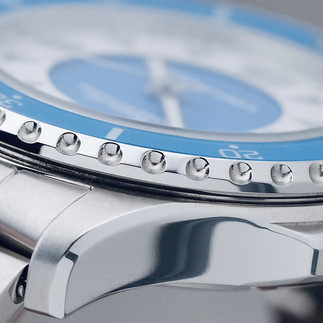
Inside the cool and hefty case we find a regulated Miyota 9039 caliber (4Hz/±42 hours of power reserve) made to run at ±5 seconds per day which is excellent at this price point alone. The movement is located behind a finely decorated screw-down crown case-back which together with a meaty screw-down crown of 7.8mm endow this model with a more-than-necessary 300 meters of water resistance. The top crystal is a flat piece of sapphire and we find the same material on the bezel insert, the latter complementing a bezel mechanism made of 120 precise clicks. Indeed the bezel is perfectly torqued and quite easy to spin thanks to big circular divots machined into the bezel assembly, akin to what we saw on the Paulin Mara. Furthermore, all markings on the bezel as well as the hands and hour markers on the dial are made of generous quantities of BGW9 SuperLuminova (more on that later) for superlative nighttime legibility. And lastly, the bracelet is equipped with quick-release spring-bars, screwed links, and a tool-less micro-adjustment mechanism.
Your $695 USD are taking you a long way on specs alone.

Design
Reviewing the Bernhardt Binnacle diver has been a great experience for me on many levels. First because I just love a good diver even though this one leans more into the everyday sporty elegance I’m not too familiar with and less into the military-esque straightforward utilitarian design I’m so obsessed with. So wearing and putting the Binnacle Atlantic Swell in front of the camera has been a delight as it took me as close as I could ever be to reviewing a Swiss luxury diver which I assume shines and weighs as much as the Bernhardt does. (I’m also of the school of thought that pure horological enjoyment hits a limit after a certain price point.) Second because the Binnacle’s dial offers a fresh take on this type of watch which we don’t see as often as we could in 2025/2026. Third, because the polishing work on the case is just superb and well above what mainstream brands can offer at this price point or higher. Though I focus on micro/indie brands, I do encounter mainstream collections at events and shows and rarely am I impressed with what I see.

So let’s talk about the dial. In its center and recessed from the rest of it we find a circular window inside of which we see a wave pattern CNC-machined onto what appears to be a pearlescent dial plate. It comes with a super fine matte texture which is complemented by a subtle brushing which does indeed make this portion of the dial glow when the light hits it at certain angles. The way this section of the dial is proportioned in relation to the rest, designed and finished, grabs our attention to the center of it in an intense, mesmerizing, and target-like fashion. Note how the polished (and diamond-cut) pencil-style hour hand perfectly fits within the circle and hugs the edges of the white ring which encompassed the hour markers. The latter are large, hollowed in their center, and made of polished frames, almost touching the edges of the central blue portion back so that the hour hand and hour markers are close to one another which contributes to making reading the time a second-nature operation with the Binnacle.


The minute hand for its part, also polished and diamond-cut, reaches beyond the blue window and white ring to almost rub against the plain brushed rehaut, and appears majestic on account of its impressive length compared to that of the hour hand. This contradiction in sizes behind the two principal hands is reminiscent of the more utilitarian-focused plongeur-style hands although disguised here by the elegance of the mirror-like polishing. The seconds hand is comparatively smaller and more discreet, as it is more important to tell the time to the precise hour and minute than to the atomic second. The aforementioned hour markers deserve to be further analyzed as they are part of a sandwich-dial construction (a lumed disc sits below the dial main) but differ from most such designs as each marker is emphasized and decorated by a polished frame. The Arabic numeral and triangular hour markers are therefore easy to see during the day as they are at night when the intensity of the lume shines through each hollowed out index.

Bernhardt went as far as adding framed cut-outs outside of the main hour markers.
And so we are left with the case, the meaty and elegant case which commands a strong yet welcome poshy presence on my small French wrist. Seen from above the Binnacle has a wide profile as the dial and bezel extends the visual footprint of the watch outward, and because the two are separated from one another by a polished ring. The combination of the ceramic bezel insert and polished bezel assembly contributes to the refined allure of the Binnacle, which is further emphasized by short but tall lugs, slab-slided and fully polished flanks executed to the highest standards possible at this price point. The addition of polished chamfers which run all alongside the left side of the case and flow into the crown-guards on the right side is the final touch which gives the Binnacle such a strong—and elegant—presence on the wrist. The polished and branded crown adds a little je-ne-sais-quoi to it, and the bracelet makes for a fine accompaniment to the mostly polished case as its classic three-link design and polished accents make it look at home here.




The Heart of the Matter
As we know, this Bernhardt Binnacle diver is a reissue of the 2005 Binnacle which set the pace for the brand two decades ago. Alas, I never saw the first iteration of the Binnacle in the metal but a quick Google Search provided me with many images of it. From what I could tell, the OG looked quite superb and equally unique as the new one does, so it is amazing to see that Jamie and Michael managed to infuse their version of the brand’s iconic diver with as much personality and high standing as Fred did with the first. Visually, however, the two are very different which makes of the 2025 version a singular creation in its own right, but more importantly perhaps, this version does pay tribute to the original by being a full package on its own, a sort of one-watch-collection type of diver which we can use for any and all situations. Twenty years separate the two versions of the Binnacle and each reflects a different time period of the brand Bernhardt, and each definitely belongs to it as they are cut from the same horological cloth.

Conclusion
Many of us cherish a good dive watch and we’re always keeping an eye out for the first (or next) we could add to our collection. Looking back at the most popular microbrand divers of the past 10+ years, there seems to be a sweet spot between $500 and $1,000 USD for singular-looking, good-rounder, and solid divers…well, there used to be at least. Brands which, a decade ago, made good sub-$1,000 dive watches no longer do, or propose models which are of less value (that is spec-to-dollar ratio) than they used to be. So back then a Binnacle diver would have competed with too many similarly-priced and spec’ed options, but 2025/2026 is a whole different ball game in the micro/indy watch industry which make this model a very good value. And an interesting one at that. So go check out Bernhardt’s website to learn more about the Binnacle and the other color variants.
Thanks for reading.


