
Lorier Olympia Series II
The Sexiest Chronograph at a Thousand
September 27, 2025
by Vincent Deschamps
The sad thing, and the reality of our world today, is that many businesses do not have the courage to be unique and to stick to their guns. They feel so much pressure to sell sell sell that they go for the easy cash-grab schemes and become the most shameless demagogues. Evidently, this is also the case in our niche world of horology where many brands either imitate what another brand has done (successfully) or turn their back on their creative soul to please the masses. Which is why the market is in a weird state today. On the one hand, there are just too many brands competing for enthusiasts’ attention and hard-earned money. On the other hand, there are too many brands following the many trends which put soulless watches on the market. So either we have too much crap or too much of everything. And so in this world, a few rare brands ignore the noise and quietly and surely walk on the path they have paved for themselves.
Lorier is the latter type of brand and one which I’ve been writing about from before I created Mainspring in 2021. Lauren and Lorenzo, the duo running the operation, couldn’t give a flying fuck about what the market is demanding or what is “in.” They adore vintage aesthetics, compact packages, and attainable prices. And so they focus on doing that. I’ve been lucky to not only write about Lauren and Lorenzo (my very first profile story!) but also about several of their models for Mainspring and elsewhere, the latest being the Merlin or the most interesting non-field military watch I’ve ever reviewed. And I had yet to get hands-on with their first full-fledged mechanical chronograph, the Olympia, now in its second iteration. I believe this is the most expensive model Lorier has ever released clocking in at $999 USD, a price that remains reasonable for this type of watch looking at what we can find on the market and, as we will see, for this particular creation.

Specifications
One of the first elements of specification people often point out about a Lorier, both in positive and negative ways, is the plexiglass crystal. Ever since Watch Wisdom became a thing, roughly at the onset of COVID-19—because people had way too much time on their hand to become watch snobs?—it became alright and encouraged to bash brands that use plexiglass (or mineral) instead of sapphire because the former is less resistant to scratches than the latter. I was actually one of these people before I encountered Lorier for the first time, I believe in the form of a Falcon SII I purchased in 2020. I too wanted my crystal to be scratch-free so that I could easily read the time all the time, but then I realized that (1) plexiglass is “warmer” than sapphire and therefore a bit more human; (2) it is easy to remove scratches big and small using Polywatch which Lorier packs in the box. I’ve managed to make deep gashes disappear with a tad of elbow grease.

All of this is to say that the crystal is a super domed piece of hesalite which occupies 2.1mm of the total 13.8mm of thickness. Add to that a diameter of 39mm and a lug-to-lug of 46mm and you get a compact and comfortable watch to wear. Despite the fact that the Olympia SII has a fully fledged automatic chronograph caliber within—a three-register TMI (Seiko) NE88 caliber (4Hz/45 hours of power reserve) with vertical clutch and column wheel—it very much wears like the brand’s Neptune, the diver with 200 meters of water resistance. (That is a huge compliment.) The tech that goes into this caliber, which I would only poorly be able to explain, means for the watch nerd that the pusher action is sublime—crisp and precise with distinct “clicks” when starting/stopping the chronograph—which is a real delight to use. And since we were talking about hesalite earlier, you should know that the tachymeter bezel insert is also made of that material for a lil extra of vintage.

If you are a watch enthusiast, connoisseur, nerd, then you know to expect around 50 meters of water resistance for a chronograph which is exactly what we find here. The typical large, vintage-Submariner-like Lorier crown (6.3mm in diameter) screws down, the solid case-back too, but the chronograph pushers don't, which is fine friends. Just like 50 meters of WR is enough, so is the application of BGW9 on the hands and lume plots located outside the hour markers, which glow brightly enough so that we can easily read the time at night. (The three small hands aren’t lumed which would have been overkill for an automatic chronograph that is resolutely elegant and sporty but not tactical nor military.) Lastly, let’s talk about the bracelet, a flat-link stainless steel fastening system found on many Lorier models—it became a staple in the brand’s catalog—that comes with screwed links and a double-pusher deployant clasp with a sufficient six holes of micro-adjustments.

Design
And so Lorier does modern vintage very well—I would even say they excel at it—and the brand’s M.O. is to base each collection on specific models that also excelled in their respective genres. For the Olympia they borrowed inspiration from the Universal Genève Compax ref. 885103/02 from the mid 1960s, the Rolex Cosmograph Daytona ref. 6241 from 1967, and the Heuer Carrera ref. 2447 from the 1960s/70s. What sets apart Lorier from all other micro/independent brands that do vintage is the duo’s savage ability to find inspiration in something that existed before without ever directly copy/pasting any particular design element of that model. In other words, their watches look like they could have been designed by either of these brands at the same time as the models they drew inspiration from, but that they are made with modern tech and materials. Lorier has been operating in the same way ever since they got started in 2018 and I respect and admire their consistency.

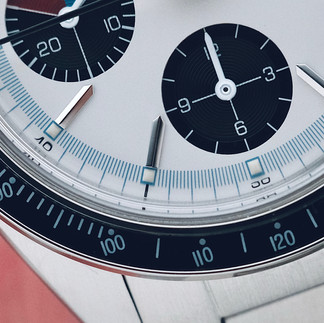
As mentioned earlier, the Olympia SII is compact for a full-fledged mechanical chronograph, it is short and nimble, and therefore it is endowed with a spectacular beefy profile. Whilst 13.8mm isn’t tall for this type of watch, it does make for a timepiece that is vertically impressive and massive, where a perfectly centered mid-case is flanked by a bulbous case-back and a tall, ship-like shaped multifaceted bezel and of course the domed hesalite crystal. The bezel is a masterpiece of horological design in its own right as the three polished facets that make up this part of the watch are superbly manufactured, polished, and just elegantly designed. Conversely, the narrow hesalite bezel insert is discreet but perfectly frames the dial, as it is separated from the crystal by a polished metal ring. The rest of the case is traditionally pure Lorier design gold with long and narrow lugs, polished chamfers, and delicate brushed touches on the upper and side portions of the case.






But whenever I first see a Lorier, I first see a dial. There is something about the dial of the Olympia SII that reminds me of the Astra, its white silvery color of course but also the minimalized fully polished Dauphine hands (which I now want to call “Lorierphine”) which are oh so gorgeous and elegant and sporty, a unique string of adjectives which also easily apply to the overall aesthetics of the watch itself. The Lorierphine hands beautifully clash with the red chronograph hand and its provocative red tip, as well as the three tiny hands found on the sub-registers. The latter are decorated with super classic chronograph-like circular channels which convey a perpetual sense of motion—Lauren and Lorenzo not only are accomplished designers but also eloquent and romantic writers—and are recessed from the dial main. We also find beautiful polished, applied, and faceted hour markers hugging a pale blue minute track which welcomes the framed rectangular lume plots.




The Heart of the Matter
There are two hearts of the matter here. First, the fact that Lorier is indeed consistent in the way it designs, manufactures, finishes, and prices its collections. I would say Lorier is extremely consistent in this, as consistent as is the rotation of Earth on its own axis, and that leads to a guaranteed series of successful releases and of exceptional watches. Each and everytime. Second, the fact that the Olympia Series II is a complete package, visually and mechanically, sold at a very reasonable price of $999 USD which truly blows my mind. I’ve reviewed more affordable fully-fledged chronographs before but they could never compete with the Olympia in terms of quality and uniqueness. As I often say, we cannot put a price tag on singularity in design and Lauren and Lorenzo should, at last, consider charging us something for their exceptional creativity. It feels as if they’re only charging us for components and shipping. Mind blowing indeed.

Conclusion
The Lorier Olympia Series II was announced two days ago on September 25, 2025, and made available for sale yesterday, September 26. So for once in my lifetime I’m telling you about a Lorier which you can actually purchase after reading a review on here! This is cause for celebration as is this superb automatic chronograph which retails for the modest sum of $999 USD as we already know. You do get a lot of watch for this amount and some, and more importantly, you can taste the sublime consistency of Lauren and Lorenzo and of the unique world of modern vintage horology they have created for themselves, and accessorily, for you and I. So I won’t waste any more of your time and encourage you to click here to get one of these shipped out today ASAP.
Thanks for reading.


