
Nivada Grenchen X Chronofactum Antarctic Chrysocoll
When the Ice Meets the Earth
March 20, 2026
by Anna Kubasik
There is something a little bit contradictory about holding the Nivada Grenchen x Chronofactum Antarctic Chrysocoll . Chrysocoll - that vivid blue-green copper silicate mineral found along the edges of copper ore deposits - belongs, by geological logic, to the driest and hottest corners of the world. Chile. Arizona. The Saharan fringes. It is a stone formed in heat, in aridity, in the slow oxidation of copper veins. And yet here it is, set into a watch named after the coldest place on Earth.

The Brand Behind the Watch
Before we get to the stone, a little context matters. Nivada Grenchen is a Swiss brand with roots going back to 1926, from the small town of Grenchen in the Solothurn region of Switzerland. Jacob Schneider founded the first manufacture there, and in 1976 his son Max took over the company.
They have always been a brand that made serious, tool-oriented watches, the kind that explorers actually wore, not just admired. As early as 1930, Nivada Grenchen was one of the first companies to produce automatic watches, and by 1950 they had created the first waterproof automatic, which they named the Antarctic. It was not a marketing name chosen to sound adventurous. The watch was the actual choice of members of the U.S. Navy's Operation Deep Freeze One, who wore it during their expedition to the South Pole between 1955 and 1956.
The brand went quiet for decades before being revived in 2018, bringing back both the Antarctic and the legendary Chronomaster. The revival has been handled with respect, no unnecessary modernization, no inflated sizing, no chasing of trends. The watches feel like they belong to a continuous story rather than a reboot.

The Collaboration and Why It Makes Sense
Chronofactum is a German retailer with a long reputation in the independent and microbrand watch space, known for working closely with smaller manufacturers to develop exclusive pieces rather than simply reselling catalogue models. Their collaboration with Nivada Grenchen around the Antarctic is one of those projects where the concept and the execution feel like they were made for each other from the start.
The choice to use chrysocolla as the dial material feels like more than just an aesthetic decision. Chrysocolla is a mineral found in oxidized zones of copper ore deposits, and its colors are extraordinary: deep ocean blues, vivid turquoises, earthy rust-browns and greens, all swirling and merging like a satellite photograph of coastlines and ocean currents. Put that on the dial of a watch named "Antarctic," a watch with a genuine polar expedition in its history, and suddenly the connection feels completely understandable. You are wearing a map of the world on your wrist, on a watch that was once worn at one of the most remote points on it.
The edition is limited to just 50 pieces, and crucially, each one is a true individual. Because chrysocolla is a natural stone, no two slabs of it produce the same pattern. Chronofactum photographed every single dial and numbered them individually, so buyers could choose not just a serial number but the specific piece of stone they wanted to own. It is a level of personal touch in the customer experience that larger brands simply do not have the patience or the flexibility to offer.

First Impressions
Looking at the product photos before the watch arrived, I was drawn to the dials immediately. But I also had some doubts. Stone dials have become a popular trend in recent years, and there is always the risk that they can feel like a shortcut, where you take a beautifully patterned material and let it do all the work while the rest of the watch is just ordinary. So I was not sure what to expect when it came to the complete package.
Luckily, I was positively surprised. The stone is stunning in photos, but in person the combination of all the elements together is what really makes it all work. The dial is the centerpiece, but nothing around it feels like it was just there to hold the stone in place. Every part of this watch has been thought about, and you feel that when you hold it.

The Dial
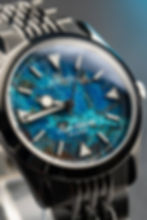
The piece I have here is number 48 out of 50. Mine is particularly dramatic: deep ocean blues dominating the center, with veins of turquoise and patches of dark rust-brown breaking through like continental shelves seen from a great height. There are lighter areas where the mineral seems almost translucent, and darker zones where it becomes dense and heavy. No photograph fully captures the way it looks in the hand, because the stone has a three-dimensional quality that changes with every shift in light and angle.
In direct daylight it is vivid and electric, the blues almost glowing. In softer indoor light it becomes more contemplative, the colors deepening and settling into something quieter. It is the kind of dial you can look at for several minutes and keep finding new things in it, the way you might stare at a painting and notice a detail you missed before.

The applied indices are polished steel, generously filled with Swiss Super-LumiNova, and they sit cleanly on the stone surface without competing with it. What I noticed is that the lume charge is strong enough that in low light conditions, before it gets completely dark, the indices glow bright enough that you can still sense the texture of the chrysocolla underneath them. The stone does not disappear entirely, it is more like the lume and the dial are still having a conversation. It is a small thing, but it adds another layer to the experience of wearing this watch.

The Hands
The hand selection deserves its own mention because it adds something genuinely interesting without taking anything away from the dial. The hour hand is the lollipop style, with a slender stem and a circular lume-filled disc at its tip. The minute hand is a sword type, longer and slightly more assertive in shape. Together they create a small visual contrast that gives the dial an extra touch of personality. It is the detail that you might not consciously notice at first, but once you see it, it becomes one of the things you might appreciate the most. It makes the watch feel a little quirky (in the best sense), and it ties directly back to the vintage character of the original Antarctic references. The combination works well with the stone dial because it adds something “extra” without competing with the pattern beneath.

The Case and Crystal
The case measures 38mm in diameter and 45mm lug to lug, with a height of 12mm. Those numbers might seem modest to anyone accustomed to the current fashion for large watches, but on the wrist the watch has a noticeable presence.
The lugs are one of those details that are difficult to overlook. They are not the simple straight or curved lugs you see on most tool watches. They have a beveled chamfer running along their forward edge, and that chamfer is polished while the rest of the lug surface remains brushed. The result is that when the light catches the watch at a certain angle, the lug edges catch it and reflect it back sharply, like a thin line of light running along the case. It is a small touch of dressiness on what is otherwise a sporty, robust watch, and it lifts the design noticeably. It does not make the watch dressy exactly, but it adds a certain refinement, a little sparkle, that makes it feel more considered. Overall the case is a mix of nicely brushed and polished edges (the bezel is also polished) which offers a sweet spot between scratch resistance and a little “bling” that we sometimes like to wear on our wrists.

The double-domed, anti-reflective sapphire crystal sits above the dial nicely, but sometimes it is easy to forget it is actually there. Seen from the side, it rises gently above the bezel without adding too much thickness to the watch overall.
Turning the watch over reveals one of my favorite features. The caseback is solid stainless steel, no exhibition window, which in my opinion is the right choice for this particular watch (and this particular mechanism). But it carries a gold-toned medallion that tells the whole story of the watch in miniature - the Antarctic scenery, the polar station, an aircraft, and the words "Nivada Grenchen" and "Antarctic." It is dramatic and old-fashioned in the best possible way, like something stamped on a medal from a real expedition. My piece shows the number 48/50, which reminds you every time you pick it up that this is not just a watch from a catalogue.

The Crown
The crown is proportional in size, rounded and quite pleasant to grip. It is screw-down and unscrewing and screwing it back is smooth and satisfying. Winding the movement through the crown has a particularly nice feel to it, with a pleasant resistance and a clean sound that suggests good quality in the mechanism. It is this small sensory detail that watch people notice and appreciate, and it contributes to the overall sense that this is a well-made object. The blue Nivada "N" on it is a nice finishing touch, a very elegant and satisfying little detail.
The Bracelet and Wearability
The Beads of Rice bracelet is an excellent choice for the Super Antarctic, and it is one of the nicer examples of this style I have come across in independent watchmaking lately. The links are small and rounded, articulating smoothly and draping naturally around the wrist with a comfortable, almost hugging feel. It does not sit rigidly or create gaps, it moves with the wrist and it makes you forget it is there after a few minutes.
The clasp carries a micro-adjustment mechanism, which is of course a very practical addition. During the day, or as seasons change and wrist size shifts slightly, being able to move the fit by a notch or two is something you appreciate more than you expect to.

One thing worth mentioning for anyone with a particularly small wrist: the bracelet has male type end links, which means the effective wear size is slightly larger than the 45mm lug-to lug figure suggests. On my 14cm wrist it wears well, but if your wrist is on the smaller side, it is worth keeping in mind. The good news is that switching to a strap solves this entirely and also opens up some interesting possibilities. A smooth, single-colour leather or rubber strap would make the watch feel more compact and give it a different personality. Something restrained and clean, in a natural color, would complement the chrysocolla beautifully. I am looking forward to trying some combinations. If you wanted to go in a more extravagant direction, an exotic leather strap could give it a quirky, bold look that would actually suit the unusual character of the dial. It would not be my first choice, but I can see how it could work.

The Movement
Inside the case is the Soprod P024, an automatic movement manufactured in Switzerland by Soprod SA in Les Reussilles. It runs at 28,800 vibrations per hour, has 25 jewels, and offers approximately 38 hours of power reserve. It is a reliable, well-regarded movement, not exotic, but honest and well-suited for this watch. The 38-hour reserve means the watch will still be running when you reach for it after a weekend away from it. There is nothing here to complain about, and nothing that distracts from what makes the watch genuinely special.

Lume
In the darkness, the dial transforms into something almost unrecognizable from its daytime appearance. The blues and greens of the chrysocolla fade back, and what remains are vivid green hands and indices glowing strongly against a dark background. The lollipop disc on the hour hand is the dominant element, followed by the triangular markers at the quarter hours and the baton indices between them. Reading the time at night requires no effort at all. It is a watch that functions as well in the dark as it looks in the light.

A Watch You Do Not Get Bored Of
There is a word that sometimes feels overused in watch circles - “GADA watch” - but it fits here genuinely: this watch has that quality of being the only one you would actually need. Not because it's super minimalistic or because it impresses other people immediately. More because it is the kind of watch that reveals itself slowly. The stone changes throughout the day (and probably throughout the seasons) depending on the light. The chamfered lugs catch the sun at certain angles. The hand shapes reward a second look.
Wearing it on the Beads of Rice bracelet is one experience. Putting it on a flat leather strap will be another. The dial will interact differently with different environments, different seasons, different outfits. This is not a watch you will look at once or twice, decide you understand, and then stop noticing. This edition of Super Antarctic keeps you engaged, and that is a quality that no price tag can guarantee and no specification sheet can describe.
Value and Final Thoughts
At €1,385, the Nivada Grenchen x Chronofactum Antarctic Chrysocoll watch offers something that it’s difficult to achieve for mass production. Every piece is unique by definition, the movement is Swiss and reliable, the case finishing is careful and considered, the bracelet is genuinely comfortable, and the story behind the watch is real. The 38mm size is a confident, well-thought choice that suits the character of the Antarctic and makes the watch genuinely easy to wear every day.
Every dial exists once. The pattern of blues and greens and rust across its surface will never be reproduced exactly anywhere. Every time I pick this watch up, I spend a moment longer than necessary just looking at it, finding something I had not focused on before. That, more than any specification, is what makes it worth owning.
Specifications:
Reference: Nivada Grenchen Antarctic 32024A × Chronofactum
Limited Edition: 50 pieces, each individually numbered
Case: 316L stainless steel, brushed and polished
Case Diameter: 38 mm
Lug-to-Lug: 45 mm
Case Height: 12 mm
Lug Width: 20 mm
Water Resistance: 10 ATM / 100 m
Crystal: Double-domed sapphire with anti-reflective coating
Caseback: Closed, with IP gold Antarctic expedition medallion
Dial: Genuine Chrysocoll mineral stone, matte
Handset: Cream / Swiss Super-LumiNova Cream 148 C.Lum
Indices: Applied, with Swiss Super-LumiNova Cream 148 C.Lum
Movement: Soprod P024 automatic (Swiss Made)
Frequency: 28,800 vph (4 Hz)
Jewels: 25
Power Reserve: 38 hours
Date: No date (true no-date configuration)
Straps: Leather or rubber with quick-release spring bars, steel buckle
Price: €1,385 (incl. VAT, EU customers)
Available from: Chronofactum — chronofactum.com


