
Xeric Retroscope Jump Hour
The Positively Triple Trouble Watch
April 2, 2026
by Vincent Deschamps
There are still many “firsts” to have in horology for everyone and for us as well even though we’ve covered quite a lot already on Mainspring. There is a whole world of unusual complications we have yet to explore, for example jumping hours and rétrograde minutes, and we haven’t featured them before because they tend to be on the expensive side of things which we are not keen on discussing. Because traditionally these complications are powered by in-house mechanical movements or custom modules fitted to mechanical calibers which fetch higher prices. And it makes sense that they do as they are mechanically intricate and rarer than the typical time + date movement which have been around for a serious amount of time. You know what though? It appears that both aforementioned complications are older than one might think. The first jumping jour mechanism was allegedly invented in 1883 by Austrian engineer Joseph Pallweber whilst the first retrograde (hour) complication in 18th century Germany.
Throughout watchmaking’s history, these complications were first licensed and then manufactured by high-end brands and mostly out of reach for enthusiasts with modest budgets or with different life priorities. And even today, brands (even small ones) which offer unusual watches, for example wandering hour complications, ask many thousands of dollars for their creations which they make in small quantities and reserved for a chosen few. However, when one peruses the world’s extremely wide web in search for singular complication timepieces, one might come across Xeric and its comprehensive catalog of affordable and attainable rare complications. From double-rétrograde and wandering hours to jump hours and linear chronographs, Xeric does it all at relatively—and surprisingly—small price points. For example, today’s protagonist, the Retroscope Jump Hour Gray Yellow, is a quartz-powered jumping hour rétrograde minute machine which will only set you back $299 USD for which you get a lot more.

Specifications
Xeric is a brand I’ve heard a lot about for many years, however I had yet to see a model in its catalog which would speak to the hardcore tool watch nerd in me. I don’t typically do the unusual and bizarre in watchmaking and feel most comfortable writing too many words about the latest toughest diver or affordable field watch. But somehow, a video presentation of the Retroscope popped on my screen one day in which Xeric’s co-founder, Mitch Greenblatt—whose career in horology began in the late 1990s—presented the functionality and fascinating mechanics behind this complication. He spoke about it with so much passion that it became immediately apparent that he, and Xeric, had created something unique in our niche world of horology. Plus, when I saw that the Retroscope Jump Hour only retails for $299 USD, I thought I ought to check it out and educate myself about a different genre of horology, proving that any type of watchmaking is for everyone as long as we find the right door through which to access it.

At its mechanical core, this model was built to be a functional and a reliable everyday timepiece. Its body is made of bead-blasted 316L stainless steel and measures 39mm in width, 44mm lug-to-lug, 13mm thick, and comes with a 22mm lug width. The Retroscope Jumping Hour appears larger than its paper dimensions might suggest on account of the majorly rectangular profile of its case and the formidable dial real estate the double-complication mechanism offers. With a pressed-on case-back and two pump-style 5.8mm pushers, it is endowed with a respectable 50 meters of water resistance which is indeed enough for most everyday activities we humans realistically engage in in real life. The aforementioned pushers are located on the upper right case flank and complemented by cross-hatched knurling on their outer surface to make them easy and satisfying to use. The jump hour and rétrograde minute complications are provided by a custom quartz caliber equipped with Miyota gearboxes and that is all we know about it.

The utilisation of the movement’s complications is quite simple and fully documented on Xeric’s website, as setting the time is quite satisfying activating the pushers in a precise series of steps. And one has the possibility to fix the alignment of the minute hand and hour disc should they come out of order. Moreover, the Restroscope Jump Hour is equipped with a flat piece of sapphire crystal complemented by several layers of inner anti-reflective coating so that we can easily read the time. The hour is also displayed beneath what appears to be a magnifying piece of glass for that same particular reason. This model ships on a silicone strap color-matched to the case and hands, equipped with quick-release spring-bars, bead-blasted pin and buckle, and tapers to 17.6mm at the clasp for a comfortable wearing experience. And it should be noted that the experience of wearing the Retroscope is rather unique as the case commands a strong wrist presence even though it only weighs 92g which is objectively excellent.

Design
So I have mentioned multiple times already that the Xeric Retroscope comes with a jump hour and rétrograde minute complications but we have yet to discuss what these are. The first means, in layman’s terms, that the hour is indicated by way of a disc instead of the typical hand and markers combination which jumps to the next hour once the minute hand made a full revolution around the dial. Typically, jump hour watches come with a hour disc and minute hand or two discs which show the hours and minutes, and sometimes, but more rarely, a third disc showing the running seconds. The rétrograde minute means the minute hand swiftly flies back to zero once it has reached 60 on a linear scale instead of a circular one found on most traditional watches. And a rétrograde complication could also be attributed to the hour hand and in some cases, the date wheel. And there are double-rétrograde watches where both the hour and minute hands jet back to zero on two separate linear scales as Xeric offers with the Timeline Retrograde.
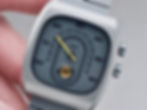
I was prompted to check out the Retroscope Jump Hour for two reasons: first, as we know, for the extremely affordability of its two unusual complications which I never thought could be had for less than $1,000 USD let alone $299. Second, because of the singularity of its design and how fun—to use a pedestrian adjective—it looks. What first drew me in is the massive aspect of its rounded rectangular bead-blasted case, shaped akin to a 1980s piece of intergalactic equipment or the most unusual concept car. Its sides account for most of its height, straight like concrete walls which were softened by way of wide chamfers which run from the very tip of each hooded “lug” to the other. The quotation marks around the word lug refers to their actual absence as instead Xeric fully integrated the strap within the case which reinforces its unusual profile and helped in keeping the lug-to-lug relatively short. Moreover, I love the highly technical aspect of the cross-hatched pump-style pushers on the right side of the case.

Then within this massive body of protected steel we find a retro-shaped dial visible through the equally retro-shaped crystal which sits on a narrow rehaut topped by what appears to be a black rubber gasket. Below is a massive darker gray textured dial on which the minute hash-marks and numerals, as well as the brand’s “X” logo above the pinion, are printed in glossy black paint. Towards the center and framing the pinion and jump hour window we find a double track of black lines which emphasize the rectangularity of the Retsotrocope’s case and dial. Below the pinion, the date aperture is made of an applied brushed gunmetal circular frame and an inner bevel which plunges down the yellow disc on which the hour numerals are printed in black. Lastly, the minute hand is equally striking as it is also painted yellow and crosses over (and is part of) a black pinion cap, so that it pops from the dark gray dial yet floats right above it so that it is relatively easy to track time to the precise minute. What a show!

The Heart of the Matter
What is impressive with the Xeric Restroscope Jump Hour is the fact that the brand offers two unusual complications for a meager sum of money in addition to giving the wearer a singular horological experience, as the design of the case and dial are as unique as its internal mechanics are, which again is singular and most likely unheard of in the micro and independent side of horology. From what I understand, jump hour watches rarely integrate a running seconds hand or disc as the main interest of such timepieces is the jumping hour and the mesmerizing spectacle it offers. The same seems to be true of rétrograde minute watches unless they fetch astronomical prices. Thus, the fact that the Restroscope does not have a seconds hand is totally fine and does not lessen the wearing experience or intrinsic value this formidable watch is endowed with, which would have been the case with pretty much any other type of timekeeping device as we watch nerds and enthusiasts are hugely dependent on having a seconds hand.

Moreover, with this collection, Xeric manages to democratize—and hopefully populariz—two very unusual complications which are normally only found in much higher-end and luxurious timepieces and rarely bundled together into one singular watch. $299 USD is very little money to pay not only for the functionality of the Retroscope, but also for the singularity of its design and the overall good quality of its manufacturing and finishing, as you can see from the photos inhabiting this review.

Conclusion
I’m so glad the video presentation of the Xeric Retroscope Jump Hour randomly popped on my screen one fateful day as otherwise I would have never reached out to the brand to review this model, and I would have never been able to at last discover what Xeric is all about. (This also prevented me from dying an ignorant watch nerd.) I’m still feeling bewildered by the extreme value this watch has to offer as well as how accessible and attainable the brand managed to make these two incredible complications. The Restroscope by the way comes in 11 color variants most of which are readily available to purchase on the brand’s website and some others, like the Gray Yellow we reviewed today, are on pre-order with a shipping estimated for July of this year. I hope to be able to tell you more about Xeric in the near future.
Thanks for reading.


