
Botta Tres 24 Black-Green
The Hybrid Time-Telling Device
September 30, 2026
by Vincent Deschamps
The ways in which we have been displaying and reading time has gone full circle in the past 5,000+ years. From the first sun dials and water clocks to pendulum and atomic clocks, mankind has concocted many strategies to measure and display our most precious resource we tend to waste generously. Ever since wristworn timepieces made a first solid appearance at the beginning of the 20th century (yes, the Cartier Tank being one of the first to have made several cameos on many wrists at a time when most folks still used pocket watches,) time has mostly been displayed on dials on a 12-hour scale instead of 24 for one of many reasons: many ancient civilizations split the day in two 12-hour segments differentiating day from night; it’s easier to read 12 hours at a distance; and for many people counting the hourly chimes of clock towers on a 12-hour scale was easier to do than on a 24-hour one. However, to some it felt (eventually) more natural to read the time on a 24-hour scale since there are 24 hours in the day.
As you might have put two-and-two together already, today we’re going to chat about a watch that displays time on a 24-hour scale and for that we’re going back to studying Botta, the German brand that specializes in single-hand timekeeping devices which has also dipped its toes into 1+ hand devices. Many moons ago, we looked at a blacked out version of Botta’s most iconic collection, the Uno, which had a long single hand used to read the hour and minutes on a 12-hour scale. With the Tres 24 collection, Botta retains a part of this design philosophy and morphed it into a modern and precise time-telling instrument: all 24 hours of the day are displayed on the dial and a minute hand makes it possible to read the precise time to the very minute. This unusual combination creates a visual duality which is intriguing, charming, and actually constitutes a way of reading time that one can get used to faster than one might have thought. i.e. I quickly got the hang of it and got smitten with this time-telling device.
And as we will see, there is more to the Botta Tres 24 than a fine strategy to display the time.

Specifications
A long time ago, like a long long time ago and somewhere around 2012 or 2013, I spent what seemed to be the enormous sum of $40 USD to get a single-hand watch off eBay. I can’t remember the name of the brand because the watch only ticked for about three months before the quartz caliber either ran out of juice or simply broke down, so it didn’t leave a lasting (or positive) impression on me. Whatever happened to it, the watch was a piece of crap but I was very much intrigued by the idea of displaying and reading the time by way of one hand because I romanticized the idea of knowing approximately what time it was, thinking that I could get away with arriving at a key work meeting at around 10am and not 10am on the dot. Back then I was also a hardcore minimalist and I enjoyed using whatever object or device that was as simple as it could be, regardless of whether or not it was actually easy to use or useful. So I liked the idea of a single-hand watch but I didn’t care to spend more than $40 USD to get a good one.
Over time, my slow-at-getting-things brain understood that an object could be both beautiful and poorly made, and the initial joy we might experience from using it is quickly overshadowed by the frustration that overtakes our body and mind as soon as it stops working. So I started investing a little more money to get better-made items that were equally as visually pleasing and original as the cheap ones, at which point I came to the head-bashing conclusion that quality is of equal importance as beauty insofar we want to use these unique objects for longer than a few days or weeks. (And that goes without saying for man-made stuff as well as the humans we deal with on a daily basis who should be good folks.) And that is the first element about the Botta Tres 24 we’re going to discuss: how good the watch is, not only in the sense that it is made of good components, but also because it is well manufactured and finished. Because there are many people who believe that simple-looking watches shouldn’t cost too much money.

This idea must come from the unfortunate proliferation of fashion watches whose quality was as poor as they visually lacked soul. We must have convinced ourselves that something that looks simple should be simple to make and equally simple to acquire for a small wad of cash. But that ain’t true of anything you could think off: a $5 USD fabric strap won’t last as long as a $50 USD one (in theory at least); a $5,000 USD Dacia won’t be as proficient at off-roading as a $100,000 USD Land Rover Defender (unfortunately for my non-existent car-purchasing budget.) And thus, the Botta Tres 24 doesn’t cost $40 USD but €2,050/$2,323 USD on a natural rubber strap (we will discuss all options in the conclusion) as this is how much the brand has to charge the customer in order to guarantee an almost lifetime of horological enjoyment. And you get a lot of value for this investment starting with the case: a tri-titanium construction which means that the mid-case, case-back, and bezel are made of titanium (of unspecified grade.)

This means the Botta Tres 24 has a sturdy and lightweight chassis which clocks in at 53g on the provided natural rubber strap equipped with a titanium buckle, and is shaped to sit comfortably on the wrist: it measures 40mm in diameter, 39mm lug-to-lug (the brand indicates 34.5/35.5mm which does not match my measurement,) 10.9mm thick (the brand indicates 9.5mm) and comes with a 20mm lug width. Just like the Uno, the case of the Tres 24 almost looks like a perfect circle if it wasn’t for the small, however super grippy, 4.4mm push/pull crown half-recessed below the fixed bezel. Beyond the case, the Botta features a top double-domed sapphire crystal with dual anti-reflective coating and a flat piece of sapphire on the case-back, and the latter is of the screw-down type for a reasonable 50m of water resistance. Moreover, the Tres is powered by a Sellita SW330-2 (4Hz/56 hours of power reserve) which is a GMT movement with a date, and there is no lume even though it appeared to be looking at the hands and pinion cap.

Design
As we now know, and as it has been now proven, the Botta Tres 24 isn’t just a watch that has a funky way to display time but also a serious piece of horological equipment made to be worn everyday. And that is one of the elements that sets Botta apart in the ocean of micro and independent brands today for it does make visually unique looking timepieces which are as technically solid and reliable as they are pleasing to look at, should they be what makes your inner watch enthusiasts heart tick of course. As mentioned earlier, at some point in my life I was very much into minimalism and single-hand watches, hence my purchase of the disposable $40 USD eBay timepiece. So I was happy to review the Uno a few years ago because it brought back happy memories of some of my first forays into the hobby. Now many years later, and having made watch journalism my profession, I can happily report that the love for singular timekeeping devices remains strong and I’m writing this review with a renewed appreciation for unique designs.

But not any kind of unique design: those which offer a different way to display and read time but which are not bizarre. Oftentimes I moan about what could best be described as being “machine” watches where hands are replaced by rotating arms and matte (legible) dials by opaque minerals. No, the Botta Tres 24 partially hearkens back to an old way of displaying time by including the entire day cycle on the dial by way of the 24 hour markers instead of the traditional 12, and thus not only borrowing from its own novel way to make single-hand watch dials but adding something extra to it: a minute hand which aligns with clean minute hash-marks. In other words, the Tres 24 gets the best of two worlds: the philosophy of indicating all 24 hours of the day at a single glance and the precision of modern timekeeping devices where a minute hand can be paired with an hour one. And there lies the design genius of this piece: the Tres 24 Black-Green is many things at once—a single-hand timepiece and a traditional practical one.

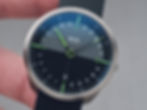
More specifically, the hours are indicated through a long rectangular hand mostly painted electric green which reaches the bottom of the hour markers printed in white on the dual-colored dial, save for the ones at the cardinal points painted in the same green color and in a larger typeface. The latter are accompanied by green applied batons half-recessed within the sloped rehaut on which is printed the minute track to which points the longer and narrower minute hand mostly painted black. Thus reading the precise time is easy and knowing that the Tres 24 is still ticking is actually made rather simple: what I earlier described as being a pinion cap is in fact a running-seconds disc where the slit in the painted green circle indicates 0/60. (Some watch enthusiasts wouldn’t be able to survive without the indication of the seconds ticking away!) Returning to the dial itself, the top half is painted in gray to highlight the AM hours while the bottom half in black to indicate the PM hours, as it is often the case on GMTs.

A quick mention should be made about the case which has the same profile as the one the Uno we looked at a few years ago: almost perfectly circular, with lugs so short that they could almost not exist, at least looking at the Tres 24 from above, which are blocky seen from the side and remind me of the piers of a bridge where the parapet is composed of the curved section in the center of the mid-case. And the latter has also something of a flying saucer as the sides move up and out to meet a chamfered fixed bezel. In other words, the case of the Tres 24 is highly architectural and aesthetically perfectly complements the singular dial layout.

The Heart of the Matter
There are two elements about this model which constitutes today’s heart of the matter: first, there is the unique combination of the 24-hour dial that divides AM and PM hours which is combined with a minute hand as found on “normal” 12-hour watches so that the wearer can keep track of the precise unfolding of the day. The 24-hour dial is something Botta has done before as a continuation of its visual experimentations of simplifying the display of time on wristworn devices. It is a rare thing to do and one which we’ve only see once before on Mainspring in the Vasco All-Terrain/Off-Road. Second, and perhaps more importantly, is the fact that Botta managed to preserve its unique way of designing watches for other types of timekeeping devices (and with more traditional hand setups) from its iconic single-hand Uno collection through a 24-hour GMT watch because both are connected through the clean and minimalist design ethos infused onto their dials, as well as for the superb architectural case. Another way to look at this is as follows: it can’t be easy to run a brand on a singular concept and few are the brands which can do so successfully.

Conclusion
What seems to be common to many German brands we write about is the fact that they offer the possibilty to configure their watches. The Botta Tres 24 Black-Green as presented here retails for €2,050/$2,323 USD excluding taxes, but it can be had on a leather strap for €1,950/$2,214 USD or €2,030/$2,305 USD, stainless steel bracelets for €2,100/$2,385 USD and €2,130/$2,419 USD (black version) or milanese bracelets for €2,220/$2,498 USD and €2,270/$2,578 USD (black version.) Moreover, the Tres 24 comes in two additional colorways: Black-Orange and White-Bordeaux, and in a 45mm diameter variant (which comes with an additional colorway,) as well as in either diameters in quartz for €690/$783 USD on the natural rubber strap for example. So many options to choose from and a dramatic price drop should you opt for the battery-powered version.
Thanks for reading.


