
Benrus Sky Chief Stratus Grey
Changing the Melody of Reviving Icons
July 10, 2026
by Vincent Deschamps
To many of us watch enthusiasts, heritage and legacy hold supreme power over any other factor when deciding which watch to add to our collection. Or which one to wear in the morning. The idea of strapping a timepiece with a pedigree decades in the making is the most seductive one, as it infuses the beloved object with greater significance and legitimacy—which does matter to many who buy from decades-old brands but not so much to those who buy from micro houses of horology. (I’m typically of the latter type.) However, without denigrating the whys of those who buy into the most popular of brands, gravitating towards collections which have existed for many years, or which have been brought back to life eventually, enables us to travel to different times to think about the contexts within which certain models or styles of watches were born. Because what matters in this instance is understanding their historical relevance and how they shaped an entire generation of watchmaking, and influenced yet another one.
This is why many relish owning an Omega Speedmaster Professional because one of them made it to the moon. Or why such a great number of collectors do get a Rolex Submariner for it is linked to the development of professional underwater exploration. Of course, one might justify buying this or that iconic model for the wrong reason, but Rolex and Omega and Seiko and Jaeger-LeCoultre continue to hold a great deal of influence onto enthusiasts for these very reasons. Some microbrands, akin to MKII, Tuul, and Vario, find ways to re-interpret certain historical models to tell the story of their genesis, and must, in order to offer compelling collections, adapt well-documented and popular designs to their own visual sensibilities. Benrus is different in many ways for it not only bridges the past and present to tell specific stories of its own heritage, but also designs and specs out the type of tool watches which shouldn’t make sense today. A 34mm field watch anyone? What about a 36mm triple register chronograph?
Exactly. And that is why I’m particularly excited to tell you about the Sky Chief Stratus Grey.

Specifications
Even though Benrus’ story goes back many years before World War II, the brand is best known for its military timepieces, a few of which we’ve reviewed on Mainspring before. First, the 34mm DTU-2A/P, or yours truly’s favorite field watch of all his collecting years, which should have been too small according to contemporary discerning enthusiasts but which proved to be of the perfect size for this style of purpose-driven machine—even before Hamilton decided to make its own modern petite battlefield timekeeping device. (In my review I argued that 34mm is the right size for a three-hander. Period.) Then there is the Type 2 MIL-SPEC, the original military-issued ultra-robust and superlatively legible diver whose pedigree many brands attempted at emulating. In other words, Benrus does two things very well: (1) it nearly, perfectly, and faithfully recreates the original in their original format respecting their original visual language; (2) it gives them the modern equivalent of the tough tech they were equipped with.

Well, because it’s quite darn impressive to find a 34mm field watch in 2026 with a domed sapphire crystal, a screw-down crown and case-back, which anybody in their right mind should have been asking for but didn’t know they had do—if field watches were mainly destined to men, too few of them had the self-confidence to sport such a small version of it. (Read: the balls.) And don’t get me started on the Type 2, a technical monster of a diver which should rightfully find its way onto the wrists of Delta Force operators fighting the War Machine. Now, turning our attention to the Sky Chief Stratus Grey, we find a similar approach to assembling the perfect specifications menu, which was done so in order to pay homage to the 1940 Sky Chief’s initial mission: to accompany commercial airline pilots, and not the military, in their perilous tasks (flying airplanes in the 1940s was not as easy-going as it is now) with clarity and reliability. Indeed, even though the Sky Chief looks military, it was actually a civilian watch.
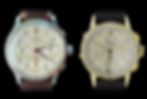
Frankly, looking at what Benrus made of it in 2026, the Sky Chief should find its way onto the second wrist of Delta Force operators because of the following: for those of them who have a healthy sense of masculinity, a perfectly sized case measuring 36mm in diameter, 42.50mm lug-to-lug, 12.30mm thick*, and coming with an 18mm lug width (making it the smallest modern triple-register chronograph I know of;) a double-domed sapphire crystal complemented by double-sided clear anti-reflective coating; a COSC certified ETA 2894 full-fledged automatic chronograph caliber (4Hz/42 hours of power reserve) equipped with a running seconds sub-register at the three, a 30-minute counter at the nine, and a 12-hour totalizer at the six; a deeply knurled 6.8mm screw-down crown matched with a screw-down see-through sapphire case-back for a healthy 100 meters of water resistance; rather neat applications of BGW9 on the hour/minute hands and printed hour markers; and a soft leather strap to tie the bow onto the cake. You got that, right?
All of this to me is quite impressive for two reasons: first, because Benrus jammed as many good components and superlative specifications into a really small package as it could, which I didn’t think I would ever see happen in my lifetime; second, because it recreated the 1940 Sky Chief’s solid built, which made it viable for professional pilots of that time period, so that it can be used again for that purpose today whilst preserving the visual appeal of the original. Which says the following: Benrus means business in the business of recreating its own iconic collections.
*The brand indicates 11.90mm on its website but my calipers said otherwise.
Design
Being who I am, I was sold on the idea of the Benrus Sky Chief even before knowing its full dimensions and complete spec sheet. All I knew at first was this: 36mm + automatic chronograph + 1940s. Yeah, I was sold I admit. But as we just saw, the American-turned-Swiss brand didn’t just pull an old design from its archives to make a mechanically dubious timepiece. It thought-through the water resistance, the caliber inside, the lume and crystal in order to make it a reliable piece of everyday horology as well as one adapted to the life of modern pilots and, I would add, of basically anybody who does anything out-of-the-ordinary—because yes, it is a small capable tool watch at its deepest core. And this fact alone needs to be celebrated because fashioning smaller utilitarian timekeeping devices hasn’t been a popular thing to do in the past few years and I do respect Benrus for daring to do so. Niche? Yes, destined to those who are looking for a particular type of chronograph which does not bode well with the current trends.
Beyond what’s ticking under and over the hood then, I think the Sky Chief is visually superb. Looking at the dial, it is almost a clone of the 1940 debut save for one minute detail: because the movements are generations apart, on the new one the small-seconds sub-register is placed at the three while it was at the six on the old, so the 30-minute counter was also switched. Beyond that, today’s Benrus added a glossy lacquered sunburst dial with azuré counter finish from which emanate gentle light plays, switching from black to anthracite grey depending on the viewing angle and nature of the light source, against which all time-telling elements easily pop. From the thin syringe-style polished hour and minute hands (which do not obstruct checking the elapsed minutes and hours) and fully polished chronograph hand, to the sub-registers showcasing fine radial groove patterns and markings crisply printed in white so that we can easily read them. “Crisp” is also the adjective I would use to describe the vintage looking numerals.
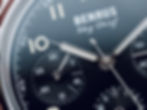
Moving outward and around the dial there is the question of the case. From what I understand, the original Sky Chief came in multiple versions including a 35mm fixed-bezel variant and a 38mm rotating-bezel iteration. To help this iconic collection make a comeback into the modern horological world, Benrus opted for a 36mm case diameter to split the bean in half, where an extra 1mm does seem to make a huge difference in the wearing experience. On my 6.50”/16.5cm wrist, 36 x 42.50 x 12.30mm wears as naturally as the 34mm DTU does, and I again rejoice in seeing smaller tool watches regardless of their genre. And similarly to how the dial is a re-issue of the 1940 original, the case is endowed with the same vintage charm we find on faithful recreations of yesteryear’s timepieces: a super narrow mid-case complemented by horizontal brushing, within which rectangular chronograph pushers retract, against which a relatively large polished and signed crown lives, and above which a steeply inclined tall polished fixed bezel resides.
Shoot, I’ve met my new grail watch.
The Heart of the Matter
You know what’s funny about today’s watch community? Is the great number of know-it-all arrogant douchebags which crawl online magazines’ comments sections to shit on watches they haven’t seen in the metal or even knew existed before the article popped on their screen. And the negative commentary regarding the Benrus Sky Chief includes its price, its petite dimensions, and the modular nature of the caliber within. Working from the last to the first: the ETA 2894 is based on the 2892 to which was added a chronograph module which some folks deem is not good enough. Well, I’ve been playing with the 2894 for a few days and it is as satisfying to use as any other “proper” automatic chronograph movement. Unless I knew the technical specificities of the movement within, I wouldn’t be able to tell the difference between the 2894 and the best of Swiss chrono calibers just by using it. Then, the petite dimensions, which I would dare say are best suited for men who trust in their manhood and members of the superior gender who are looking for a well-proportioned, proper chronograph.
And the price: CHF 3,469 (excluding taxes) or $3,950 USD which is, alright, a large sum of money I’m used to spending on any watch. But in order to act differently from the comment-section-idiots, I had to get hands-on with the Sky Chief to understand its holistic value. And value it holds—historical value which I’m starting to understand does matter to someone like me who’s hopelessly into military horology, for the Sky Chief is a worthy descendant of the 1940s original which was designed for pilots and adopted by countless popular airlines of times past as their official timekeeper. That’s cool. Also, its horological value—for it is rare, if not impossible, to find a 36mm automatic triple-register chronograph in 2026 matched with such a generous technical data sheet which puts many other utilitarian timepieces to shame. And at last, the emotional value—for it makes special thoughts and feelings bubble in my mind which I have rarely experienced before, as I know I have found one of my few horological soulmates which is a great feeling to have should you ever have it.

Conclusion
Even though Benrus came up with multiple versions of the Sky Chief in its distant past, and we might see more being brought back to their well-deserved spotlight in the coming years, the brand decided to begin with two iterations of the bezel-less version: the Stratus Grey we reviewed today, named after low-altitude cloud formations characterized by horizontal layering, and the Cirrus White, named after a high-altitude clouds made of ice crystals. Benrus went big and went home with the nomenclature which hearkens back to this collection’s raison d’être—to be worn by commercial airline pilots to travel the globe with. Pretty neat.
Thanks for reading.
Credits for archival documents: Dan Catalin Buzdugan; Dragos Perju; Oana Radovanovic.


