
Laco Frankfurt 40 GMT Black
Smaller But No Less Professional
August 21, 2026
by Vincent Deschamps
The watch we’re about to discuss today proves that well-established independent brands (read: powerhouses of independent horology) have the same ability to listen to its customers as do microbrands, the latter which are known to be extremely agile and adaptable. The fact that a brand was founded a little over a century ago does not mean it doesn’t care for what people want, or that it cannot mold itself after certain trends. (Something big players of the Swiss luxury market do not seem to care about.) But here we’re not talking about designing whatever watches people ask for—in which case the brand would have no soul—but instead to show a capacity to stay focused on what it knows how to do best while sometimes peaking its head outside the design studio to listen to what could make their models even better received by the enthusiasts community. Again, this is something independent brands can do but which is however not easy to accomplish: for brands with so much heritage move slowly albeit surely.
As you might have deducted from the seven reviews we’ve published on Laco—the latter being the better one if I may say so myself—we are quite fond of the German brand for it makes high-quality professional tool watches and has cultivated its own design language even in categories which have been greatly explored by other German brands since World War II—Flieger watches of both Types A and B. What Laco does best is to continue to produce robust, legible, and distinct activity timepieces which have no match on the market—visually mostly and technically as well is many cases—and for lately it has paid a little more attention to what its most ardent fans have been asking for: smaller professional tool watches endowed with the same winning Laco design formula. Thus it made the Flieger PRO’s available in 37mm, and recently it downsized its 2020 Frankfurt 43 GMT into the Frankfurt 40 GMT. Same aesthetics, of equal robustness, but now in a modern* 40mm case format perfect for say, a 6.50”/16.5cm wrist.
*We will meander about modern dimensions shortly.

Specifications
Laco occupies an interesting place on the global watch market. Its collections can be seen as either being fairly priced for what they offer (great specs, robust construction, and purpose-driven designs) by those who value heritage and the preservation of a unique know-how. Or categorically overpriced by those who drank the microbrand value Kool-Aid a little too much and believe that cramming as many popular specifications into smaller price tags, regardless of quality and design, is where it’s at. Granted, there are many microbrands on the market today that offer very good value, brands we’ve discussed multiple times on Mainspring before with great pleasure—Maen and Astor + Banks come to mind for example—however, there will always be a little something extra missing from their watches—tighter tolerances, better finished hands, crisper printing of dial furniture—which brands that have more experience and manufacture many of their own components in-house do have. Don’t get upset: my heart flutters for microbrands regardless.

This is what makes Laco so compelling for a contemporary utilitarian watch enthusiast who has a thing for history and heritage. And even for one who doesn’t give a rat’s ass about the latter but who can nevertheless appreciate a quality tool watch when seeing one. Moreover, there is the question of modern dimensions for this style of watch which we’re doing to argue now: there is a school of thought that claims that modern dimensions means larger, for example over 40mm in diameter, as brands in the past decade have increased the diameters of their watches because they have been told this is what we want, and because we have been told by influencers this is what we want as well. Then there is another school of thought that claims that modern means smaller, roughly between 36 and 39mm in diameter, as tool watches were made before the fattening of wristworn timekeeping devices. It’s part semantics, subjectivity, and what you believe to be true. As far as we’re concerned, the Frankfurt’s 40 x 47 x 11.9mm case is perfectly modern.

As many professional watches Laco creates do, the Frankfurt 40 GMT’s case is coated with a dark sand-blasted surface treatment which enhances its utilitarian nature as well as protects it from scratches and minor bumps. It further aids in making it fly under-the-radar pretty much in the same way a stealthy bomber would in the sky—“pretty much!” The genius of combining the 40 x 47 x 11.9mm case with such surface treatment means the Frankfurt wears smaller than its dimensions might suggest which is a big brownie point in many people’s horological book. Moreover, inside the case we find a Sellita SW330-2 based Laco 330 caliber** (4Hz/56 hours of power reserve) which is a caller-style GMT caliber where it is the fourth GMT hand that moves forward in one-hour increments. (Boohoo it is not a “true” GMT!) Laco modified the caliber to move the crown to the four o’clock position to keep it from digging into the wrist, and so that it could place a second crown at the 2 o’clock to actuate the inner-rotating GMT bezel for the same reason.


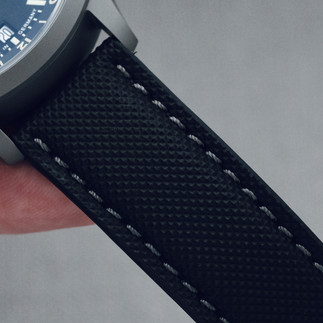
The two crows screw down, measure 6.4mm in diameter, and are endowed with highly effective knurling as Laco crowns always do. The tactile experience of such crowns is so good that I felt compelled to adjust the bezel for no real reason, also because it rotates in both directions and for that motion is accompanied by audible clicks. (This bezel would score high on a watch nerd’s nerdistic scale.) The lovely crowns are also paired with a screw-down engraved case-back which together endow the Frankfurt 40 GMT with 200 meters of water resistance, which is a lot for most of us, so is the abundance of the SuperLuminova C3 applied on the hands and all printed elements found on the dial and bezel***. (Laco’s lume never disappoints and always impresses.) To tie the bow on these incredible list of specifications, we need to add a double-domed sapphire crystal with double-sided clear anti-reflective coating, and a black water-resistant Fibertech strap which is supple, robust, and visually perfectly matches the stealthy case and dial design.

**Laco nestled the caliber within an anti-magnetic soft-iron cage but the level of its magnetic resistance is not listed on the website.
***The GMT hand and triangle on the bezel are rendered in an orange-glowing lume.
Design
For all of what was mentioned above, Laco will reasonably ask that you remove €1,850/$2,166 USD (including taxes, so remove about 20% from that price if ordering from outside the European Union) from your digital wallet which I deem to be a fair price to ask for a professional-grade activity timepiece. As mentioned above, either you belong to the school of thought that believes this a good amount of money to pay for the Frankfurt 40 GMT given its specs and quality of manufacturing and finishing (which you can only get a grasp of handling the watch in person—so believe me if you will) as well as the brand’s history and century-old know-how. Or you are a member of the uneducated school of thought that somehow believes that all of the above shouldn’t cost more than $500 USD. Yes, this sounds ridiculous but there are many ridiculous people in our niche world as they are in the world, period. So from a technical side, the Frankfurt is quite outstanding and does indeed have what professionals need to have and what we civilians don’t.

But the genius of this model actually lies in its design. You see, the same influencers who have been pounding our heads which thoughts such as watches ought to be 40mm+ in diameter also convinced us that nowadays, proper tool watches should have the following: color-matched date wheels for a seamless design; textured or stone dials because matte ones are outdated; 3D lume blocks so that we can be reassured that our watches keep on ticking in the middle of the night; no date apertures for a cleaner look. Screw that! The Watch Wisdom is so strong actually that I was also convinced that, and a little shocked to see the Frankfurt was deprived of, a color-matched date wheel. If so many hype-focused content creators tell us this ought to exist on every single timepiece then it ought to exist, right? Well, no, actually. The old-school design approach to printing black numerals on a white date disc on a black dial actually ensures easy reading of the date, something that effective design does guarantee. The Frankfurt is a tool watch.

In other words: Laco continues to apply the most effective tools of horological design for professional-destined activity watches because they work, instead of giving into watch nerds’ influencer-fueled demands. Which is why the Frankfurt’s dial is so clean, clear, and easy to read for each set of information is perfectly organized and fully integrated with one another. For example, Laco’s classic heat-blued hour and minute hands talk to crisply printed hour and minute markers to effectively tell the time, the latter being printed in a yellow-ish tint to pop from the matte black dial with double the strength. The seconds hand is mostly lumed and equipped with a plane-shaped counter-balance (the Frankfurt is an aviation GMT at its core) for the same reason, and the beveled easy-to-read date aperture located at the six o’clock. To aid in telling the time fast, the 3 and 9 o’clock markers are large Arabic numerals and the one at the twelve is in the traditional triangle + dots format found on pilot watches since time immemorial.


And the GMT functionality is equally easy to read for the same reasons: the GMT hand is equipped with an orange triangular element which is answered by the orange triangle marking 24/0 on the bezel, and for each hour of the GMT scale is easy to read, both for the even hours represented by Arabic numerals and the odd ones shown with hash-marks. In short: reading the local time or in a different time-zone is extremely efficient. The Frankfurt 40 GMT’s excellent legibility is furher enhanced, in my humble opinion, by the dark sand-blasting of the case as it makes the dial and all of its design elements pop more strongly, indicating that quickly reading the time and date is paramount to the Frankfurt’s raison d’être—because it is. The case is also a little work of art and similar to what we’ve found on other Laco’s: solid, well manufactured, with tight tolerances, slab-sided flanks, heavily-knurled crowns which are complemented by angular crown-guards, as well as short lugs that turn down. Thus, enough of what is necessary.






The Heart of the Matter
Let’s take a deep breath and summarize what we’ve learned thus far about the Laco Frankfurt 40 GMT Black: it is endowed with great specifications, high-quality manufacturing and finishing (the sand-blasting of the case is soft as silk,) a clean and legible dial, the whole being focused on robustness and legibility—exactly what professional-grade tool watches ought to have and why they’re still being made. Laco didn’t give into silly hype-generated horological demands and preserved the core design elements of its purpose-driven activity watches by keeping the dial matte and flat and the date aperture with a white disc and black printed numerals. What Laco did, however, and was right to do, was to indeed answer a legitimate demand from enthusiasts and collectors to add a smaller version of the Frankfurt GMT to its catalog. Not to replace the original 43mm version with a 40mm version, as both can co-exist in our niche world and by doing so, Laco simply made one of its best GMTs better suited for people with smaller wrists—for example 6.50”/16.5cm.

When I first saw the Frankfurt in its original 43mm diameter, I secretly wished it would eventually come in a smaller package format so that I could selfishly, and eventually, add a professional-grade ultra-legible GMT to my personal watch box. (Not that I need to have so many specifications but I do like to have them for one reason or another.) I have not made this acquisition yet but it is surely bound to happen soon—I have become a fan of Laco, should that not have been made clear already. Thus the biggest takeaway about the Frankfurt 40 GMT should be as follows: it strikes the perfect balance between wearability, legibility, and functionality in ways Laco only knows how to. The Frankfurt 40 GMT might be smaller, it is no less professional and that is what makes it shine so brightly for tool watch nerds such as ourselves.

Conclusion
In good Laco fashion, the Frankfurt 40 GMT Black can be slightly customized: one can opt for a top-grade Sellita SW330-2 for an extra €130/$152 USD and a dark sand-blasted buckle for an extra €30/$35 USD. This model also comes in a grey version which offers the same high-legibility and equally outstanding take on a professional-grade pilot watch. (I thought I would prefer the latter but the black one suited me best.) So once again, I would be hard-pressed to find something as technically wholesome and visually compelling on the market today. That’s it, you know what to do now!
Thanks for reading.


