Nodus Sector Deep Pioneer Forge
Multiple Watches Colliding Into One
March 12, 2026
by Vincent Deschamps
It might seem redundant to write about another diver, another tool watch, another GMT. We’ve seen plenty of those already—yesterday and fifty years ago—and most look pretty much the same. So there are redundancies within these genres in and out of themselves which can get tiresome and quite boring if we’re being honest with each other. However, enthusiasts and collectors keep buying these watches because brands keep making them because we keep asking for them. It’s a chicken-before-the-egg-before-the-chicken kind of situation we keep finding ourselves in ad vitam aeternam. But hey, car makers keep on making cars, builders keep on building houses, and clothiers keep on making clothes. True, the two former examples are kind of necessary to have whilst clothes are something we stack too many of in our homes and watches are definitely unnecessary. But they are important to us just like a titanium pocket knife can be, as they are part of our everyday practical and emotional carry. (EDPEC.)
So when we study another diver, tool watch, and GMT, we ought to be looking at something different. A version of either of these watches—or a watch which resulted from the colliding of multiple genres of timekeeping devices—which we haven’t seen before and which makes sense in multiple aspects—technical, financial, and visual—so that we can more easily justify giving our undivided attention to such objects. Of course, that is what we’re about to do today by looking at the Nodus Sector Deep Pioneer Forge. Five words which we’re going to be paying great attention to throughout this review because it explains what Nodus, the well-known Californian brand, attempted to, and was successful in, accomplishing: creating a deep diver which pioneers extreme value and forges Nodus’ reputation as being a good tool watch purveyor. For $625 USD the Sector Deep gives you more than it should in terms of design and specifications and that is what many of us are looking for in a timekeeping device.

Specifications
As we’ve said before, value in horology keeps taking on new meanings every single day because technologies change—they improve and become more attainable—, our design preferences evolve with time—we ditch dress watches for robust ones or vice-versa—, and globally speaking, micro and small independent brands continue to make better watches for less money. Therefore constantly widening the gap between them and mainstream brands which seem to be more and more out-of-touch with reality and most of consumers’ purchasing power. And within our niche side of horology we find brands which focus on making spec monsters and others which prefer to offer really good value by means of better tech, more robustness, and singular designs, putting them at a level where the kings of today were a few decades ago. (Everything in life operates in cycles so it does with watches.) And after having reviewed many Noduses I can tell you that the California brand does the latter kind very well—just look at this and that bad boys.

And there are many things Nodus does which many other brands don’t. For example innovating from technological and design perspectives which both improve how their watches function and how they look. Nodus created its own tool-less miro-adjustment clasp which it pairs with a well-engineered and finely manufactured double-trigger deployant clasp, which it pairs with a three-link bracelet equipped with screwed links, quick-release spring-bars, and half-links so that one can find the perfect fit. Nodus then coats all of these elements in a delicate bead-blasted finish thus creating the perfect utilitarian fastening system which pairs very well with a bead-blasted case measuring 38mm at the case, 42mm at the bezel, 47mm lug-to-lug, 13.6mm thick, and coming with a universal 20mm lug width. Which the latter makes for the perfect chassis for the aforementioned bezel which received a DLC treatment to increase its resistance to shocks, scratches, corrosion, and tarnishing. Nodus does make fine tool watches indeed.

13.6mm in thickness is good by the way for any dive watch regardless of its depth rating but impressive when taking into consideration the 500 meters of water resistance the Sector Deep Pioneer Forge is endowed with. I couldn’t tell you if this makes the Nodus one of the thinnest 50ATM divers on the market but it is nevertheless impressive indeed. The brand achieved this great depth rating by internally thickening the crystal (3.5mm) and case-back making them better suited to handle the increasing atmospheric pressure which builds up onto these two crucial points the deeper one goes. And the crystal is made of sapphire with blue inner anti-reflective coating, comes with a flat profile, and is slightly recessed from the edges of the bezel to protect it against frontal shocks. As we know, the bezel also dramatically overhangs the case to make it easy to grip and operate, and thus also has good knurling. Moreover, there is shit ton of BGW9 Super Luminova on the hands, hour markers, GMT scale, and all bezel markings.

Design
Of course design is highly subjective and we all have different tastes. But we can all recognize when we’re presented with something singular and celebrate these instances. As singularity in design is rare in horology as it is in any other creative and visual domain even though mankind has been endeavoring for thousands of years to create new things and more things all the time in repetitive cycles. So the Nodus Sector Deep has, as we now know, a great depth resistance and it pioneered a new design language which the brand first released in 2023 (check out my review of the debut iteration for Fratello) and which it has reworked and tweaked each year since in different colors and configurations. And this one, the Sector Deep Pioneer Forge, is one of the collection’s most daring versions and most accomplished ones to date as it combines a traditional time-telling functionality to a GMT one as well as a dual-purpose bezel to time dives and orient ourselves in the wild by a way of a discreet compass scale.

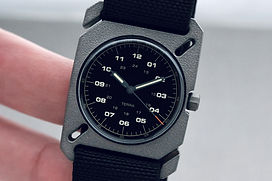
Thus this model is closely related to the Jack Mason Strat-o-Timer Titanium Diver GMT we looked at before Christmas in terms of functionality (minus the compass) although not at all in the design department. Where the Jack Mason aimed for subdued elegance the Nodus did a Bull’s Eye on boldness and legibility in ways I’ve never seen before for a diver GMT (or GMT diver, as you prefer) and I’ve reviewed quite a few of those. The first and most striking design element of the Sector Deep Pioneer Forge is how legible the GMT scale is, printed in bold white numerals and dots and paired with a semi-skeletonized red GMT hand complete with an arrow-shaped lumed tip. It's easy to see from a distance and bizarrely more striking than the hour markers even though the latter are large and shaped so they are very hard to miss. Made of triangle and soft trapezoids, the hour markers are applied, composed of silver surrounds and large areas for lume, and recessed within the steep rehaut on which its printed the minute track.


More specifically, the minute track is printed on the top portion of the rehaut where it angles in towards the crystal and its bottom half is painted red from which the model was named. Placing the hour markers within the rehaut made it possible for Nodus to make them large and legible whilst containing the proportions of the dial so that we get a 38mm case. And there is more to see on it: a bespoke hour hand with a line running down its middle, an arrow-shaped minute hand, a needle-shaped seconds hand with a lumed rectangular element, all painted in a matte white finish and leaving ample room for generous quantities of lume. And there is more still: the dial is covered with a dark anthracite color which helps in making all applied and painted elements pop whilst not creating too stark of a contrast as we normally see on monochromatic dials. This was a seemingly simple but elegant way to make the dial apparatus appear clean and legible and more different than you might have thought int the first place.

And lastly there is the case which is no less singular than the dial. It is first characterized by the overhanging DLC coated dual-scale bezel, where compass markings are incised on the flat portion of it and lume-filled, and the dive scale also incised and lume-filled but on the slopping part of the bezel. Nodus marked the first 15 minutes with dashes and added red dots below each five-minute increment indicated with Arabic numerals. This means that reading both scales is easy during the day and at night, and using them is highly satisfying because the bezel comes with 120 precise clicks. Then below the bezel we find a tall mid-case made of slab-sided flanks, muscular lugs ornamented with pronounced chamfers, and a DLC coated 7mm screw-down crown placed in a left-hand-drive fashion to ensure all-day wearing comfort. Note the clever addition of a red arrow and the word “Lock” on the crown to help the wearer screw it down in the right way. (It took me a minute to figure out how to use the crown.)





The Heart of the Matter
The horological gospel dictates that we’re lucky to be watch enthusiasts right now because we get better timekeeping devices today than we did yesterday. This has been written many times in the past I-don’t-know-how-many-years and it’s valid each day that it is written because it is true. As mentioned above, brands now offer better tech at better prices and more thoughtful designs for less money. And each day that passes, the more value micro and small independent brands offer as we saw today with the Nodus Sector Deep Pioneer Forge. From technical standpoints, this model offers more than we typically see at this price point or slightly above it, and not only it is made of the good stuff but it is also well put together. From a functionality standpoint, the Deep Pioneer Forge is a sort of horological Swiss Knife as it tells the time locally and in a different time zone, it can time events up to 60 minutes, and help you get your bearings thanks to the compass scale. From a visual standpoint, it is bold, singular, and ultra legible.

Therefore, it is a complete tool watch and the happy colliding of multiple genres of utilitarian timekeeping devices into one. Where all are seemingly integrated within one another to indeed offer a complete package at the more reasonable price of $625 USD which is way too little money to pay for such an accomplished timepiece. And you might have realized that I never mentioned the caliber within because there was so much to be said already and because I simply got sidetracked by the Pioneer’s outstanding spec sheet and novel design. Nodus opted for the Seiko NH34A which ticks at 3Hz, comes with 41 hours of power reserve, and is adjusted in-house to run at ±10 seconds per day. A caller-style GMT which makes the most sense to me for such a timepiece as it is meant to be used in multiple scenarios and not only to travel across time zones. Nodus pioneered this caliber in the Sector GMT in 2023 as well. (You can read this review about it.)

Conclusion
We’ve pretty much said it all already, haven’t we? The last piece of information you need to be aware of is that the Nodus Sector Deep Pioneer comes in three colors—the green Ranger which is sold out, the blue Admiral and anthracite Pioneer both of which are readily available on the brand’s website. Each version of the Deep Pioneer comes with color schemes which emanate from the rehaut and dial combo which was also a clever way to endow each one with its own unique identity.
Thanks for reading.