
anOrdain Model 1 Porcelain
Where The Best of Horology Comes From
September 17, 2026
by Vincent Deschamps
The survival of wristworn timepieces through multiple crises and the continuous flow of technological advances cannot be explained by the simple fact that we need them. We haven’t needed them for a couple of decades already but they remain popular and appear to become more so each year that passes. Why is that? Mankind has created more accurate and more reliable time-measuring instruments; it has diverted creativity towards other objects and machines; and it has morphed our relationship with time by moving it from an intimate one (i.e. wearing a watch) to an all-consumerist and omnipresent affair (i.e. time is displayed everywhere we look.) However, through the study of brands and the watches they make, and of those who design and speak about them, it is clear that wristworn timepieces perdure for one of many reasons: we prefer analogical time-measuring experiences; we endow them with the power to hold memories and remind of us of past experiences; they became a conduit for self-expression; they are canvases for métiers d’art.
The latter is what is of interest to us today and a topic we recently delved into looking at the Awake Son Mài - Guilloché Main “Borealis”—a machine which blends two types of traditional crafts heralding from two distinct corners of the earth. There is objectively no need for any brand to create exquisite timepieces nowadays save for two subjective particular reasons: (1) to preserve hand-made know-hows which are becoming too rare; (2) to permit brands and enthusiasts to indeed say something about who they are without having to shout it on the roofs of social media platforms. By wearing analog and mechanical timepieces we decide to press the break pedal on the fast-paced world we live in, to celebrate the art of crafting complex and beautiful instruments by hand—in other words: to cultivate what makes us profoundly human. And that is what we’re about to discuss today by taking a first look at British brand anOrdain and the Model 1 Porcelain, a timepiece that celebrates a métier d’art and a particular way to display and read time.

Specifications
One of the many advantages of creating métier d’art watches in 2026, compared to doing so half or a full century ago, is to marry traditional crafts with modern horological technology so that we can wear beautiful timepieces which can handle the rapid-firing of modern life we try to step away from by wearing a mechanical timepiece in the first place. We are, in fact, sporting complex machines to remind ourselves of where we come from and what distinguishes us from the technology which is otherwise embedded within our daily existence. In 2026 therefore we can strap a porcelain dial watch to our wrist which we can have many modern experiences with which is what prompted me to want to write about the Model 1 Porcelain. It is, first and foremost, an exquisite piece of craft I had no idea I could love so passionately, and secondly, it is an actual timepiece you can wear in and out of the office, traveling, exploring cities or the countryside, for a fancy night at or a quiet evening in sitting by the fire leafing through a very good book.

Therefore, we must first speak about everything that is not the dial in order to get a full reading of what this anOrdain is capable of. Being made in the second half of the 21st century, we can expect a few things from it, for instance a modernly-sized case which will fit many wrists: something in the lines of 38mm in diameter, 46mm lug-to-lug, 11mm thick, and coming with an 18mm lug width. These dimensions are said to be average for today’s horological world according to yours truly and the omnipresent and powerful Watch Wisdom: for an everyday timepiece should neither be too small nor too large, so as not to disappear under-the-radar and not to call too much attention onto itself. Think of it—as we normally do, connecting a watch’s proportions to other objects we are familiar with—as a well-tailored pair of eyeglasses, properly fitting shoes, and objects of home decor which perfectly fit in. Pictured on someone's 6.50”/16.5cm wrist, the anOrdain Model 1 Porcelain is legible, elegantly discreet, and subtly asking to be looked at.

And there wouldn’t be any point to create such exquisite dial should what englobes it not poetically exacerbate its beauty and protect it from the outside world. Which brings us to the following: an ever-so-slightly domed piece of sapphire crystal sitting atop the dial and complemented by three layers of clear anti-reflective coating so that we can admire the porcelain creation without too many reflections. Sapphire is also the material found on the see-through and screw-down case-back, which together with a 5.4mm push/pull crown endow the Model 1 Porcelain with a reasonable 50 meters of water resistance. Moreover, behind the second crystal we get a glimpse of the caliber within, which is no other than a LaJoux-Perret G101 (4Hz/68 hours of power reserve) which has become synonymous with higher-end microbrand offerings, offered in the A1 variant, anOrdain’s first decorated movement made in collaboration with Glasgow-based artist Rachel Duckhouse who gave the G101 a new aesthetic, mainly through a galvanized finish and custom rotor.




Design
Whenever I am confronted with the self-imposed task of crafting a review of such an exquisite timepiece, I often struggle to figure out where to speak about certain specifications and when not to, as in these rare cases, they blend in with the design and are integral part of it. Because, besides the porcelain dial which we’re about to finally discuss, the anOrdain Model 1 is also a timekeeping device which was given a stainless steel chassis which perfectly frames the dial and elevates it, akin to how a minimalist Japanese interior naturally frames a 150-year old bonsai sitting atop a hand-made wooden console. In other words, the dial wouldn’t look this good should the case not look this good, and the latter wouldn’t have a purpose without the former. And this says something about the brand: it didn’t simply figure out how to bring back the tradition of crafting porcelain dials to fit modern micro-watchmaking, but it also designed a comprehensive ensemble which is as visually striking as it is rarely found globally in 2026.

So, let’s at last talk about the dial. anOrdain has crafted its reputation and forged its niche place within the watch world by offering hand-made dials showcasing some of the best examples of traditional métier d’arts such as enameling and porcelain. The Model 1’s dial is entirely made in-house by, and under the watchful eye of Cara Louise who first creates the clay dial main by way of a custom-mold, before applying a first layer of glaze to coat the dial as if applying a primer onto a wall before painting it. She then proceeds to apply the final layer of glaze, by hand of course, which is fired at high temperatures. The result is a glassy-like finish which is endowed with tremendous depth, and on account of the multi-stage manufacturing process and the use of clay as the basis to make the dial, the finished product is an elegant and ultra-resistant unit on top of which the time-telling design elements can be added. Indeed, anOrdain successfully managed to revive a traditional dial-making technique and made it modern again.


Amongst the time-telling elements we can find on the dial there are numbers and letters designed specifically by Dutch artist Kia Tasbihgou whose numerals evoke the fine strokes of a calligraphy pen (anOrdain’s words, not mine unfortunately,) which visually perfectly marries with the traditional aesthetic of the white porcelain dial. For these elements, anOrdain opted for a deep blue color which itself circles back to a color scheme found in the ceramic-making tradition as early as 9th-century Irak, which is as timeless for this medium as black-and-white dials are for utilitarian timepieces since the middle of the 20th century. The delicate typography is complemented by portions of a traditional chapter-ring, each indicating the four minutes inhabiting every 5-minute increments, and a set of heat-blued hands whose design further anchors the anOrdain Model 1 Porcelain into tradition: the hour hand is shaped a la Breguet whilst the minute hand resembles the good old syringe-style hand, however hollowed out to a subtle perfection.

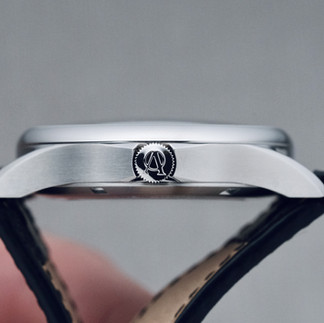
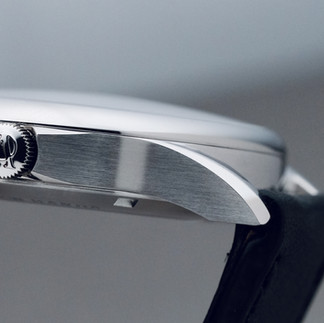
And lastly there is the case which does seamlessly complement the dial as mentioned earlier. While the former, for the lack of a more astute observation, does look old school but in the elegant, high-end kind of way, the case is resolutely modern and explains why the anOrdain Model 1 Porcelain works so well in today’s horological world: seen from above it is mainly the lugs which show their faces, short and curving in, whilst the small but grippy crown is partially recessed within naturally-formed crown-guards. From the side, the Model One’s case appears shorter than the 46mm L2L measurement suggests, as the mid-case is only partially slab-sided and equipped with lugs which angle down towards the wrist and are complemented by horizontal cuts on their underside. In other words, the case profile is modern and it plays with the light akin to a classical dancer through the strategic addition of polished chamfers on the lugs which run up towards the polished fixed bezel. And satin-brushed accents complement the mirror-polished ones.




The Heart of the Matter
Yet again, after having taken a close look at the anOrdain Model 1 Porcelain, one could rightfully claim—or re-state—that it is from the microbrand world that comes the best of horology today. Because it is one particularly difficult endeavour to create an entire brand around the idea of in-house crafted dials, which only a rare few luxury and centuries-old houses of horology offer today, and another to do so at what we should all consider to be a reasonable price point: £2,200/$2,960 USD (excluding VAT) when you take into consideration the holistic approach with which anOrdain crafted this particular horological creation—not only the handmade porcelain dial whose sheen and perfection reminds of me a few rare examples I’ve seen from brands ten times the age of anOrdain, but also the custom-finished high-power caliber which is another trick no other microbrands (I’m aware of) has played. And as this the above two factors weren’t enough, we ought to further take into consideration the custom-designed typeface and the crispiness of the applied dial elements where no imperfection can be spotted, and the blue ink which appears as though deposited on the dial through the nib of the finest of fountain pens.

Thus, if you do add up all of the aforementioned elements and tack on the superbly profiled and finished case, the thick hand-made leather strap I had yet to mention, as well as anOrdain’s country of origin—a wealthy Western country where costs of living are high and manpower cannot be had for a few cents-an-hour—(however weird it might be to mention that) then the Model 1 Porcelain is most likely the most refined and elegant timepiece I’ve had the pleasure of riffing about for too long to be had at this price point. For I tend to ramble about the impossibility of assigning a price to design, and today I wouldn’t be able to do so either when it comes to the years of expertise that went into designing and crafting the porcelain dial this timepiece is proudly presenting.

Conclusion
Many months ago I reviewed two watches from anOrdain’s sister brand Paulin, the Mara Black and Modul D Manual, both of which were visually distinct, generously spec’ed out, and offered great value when taking into consideration the two aforementioned elements. (Something I insist on as many enthusiasts and collectors thought they ought to cost less, much less.) I was drawn to them for their singular aesthetics which nicely paired with solid construction and a modern appearance, and even though the anOrdain Model 1 Porcelain is a very different creature in its own right, I see in it the shared philosophy which links the two brands of putting out in the wild world refined horological creations imbued with character, singularity, and a passion for finely made things. So if you’ve become as enthusiastic about the Model 1 Porcelain as I have, you’ll have to set aside £2,200/$2,960 USD (excluding VAT) for it.
Thanks for reading.


