
Marathon CeraShell® Navigator Quartz
Where Bioceramic Belongs
June 18, 2026
by Vincent Deschamps
When the Swatch Group announced its first news-grabbing collaboration with Omega in 2022, from which was born the MoonSwatch, many of us enthusiasts, collectors, and members of the watch media questioned, discussed, and argued about bioceramic, the proprietary case material Swatch invented for this collection. Some of us got starry eyes gazing at this new unique amalgam of ceramic powder and biosourced “material” derived from Castor oil—a synthetic polymeric material otherwise known as plastic, albeit not made from petroleum—and others amongst us plainly described the new invention as being “plastic.” So in reality it is much more than what most objects we use on a daily basis are made out of, and is a legitimate upgrade for Swatch which, for the most part, does make a ton of actual plastic watches. What bothered some of us actually more was the combination of this new material with otherwise crap components (plastic crystal and chronograph pushers) which made of the MoonSwatch a throw-away timekeeping device.
Enter Marathon and the new CeraShell® Navigator Quartz whose case is made of the brand’s own proprietary mixture of bio-sourced plastic and ceramic powder, creating a lightweight and sturdy chassis for Marathon's most iconic collection. Arguably, CeraShell® and Swatch’s Bioceramic are one of the same thing, however—and the reason why I’m reviewing it—is that Marathon assigned this new material to a professional-destined watch which it equipped with an array of holistic specifications which make it ready for the battlefield and overly prepared for civilians’ daily routines. For it is one thing to invent a new case compound to make the news around the world, and to create mayhem outside of Swatch boutiques in the quaint streets of downtown Paris, but yet another to put it to good use for a robust tool watch. Moreover, I appreciate the upgrade to Marathon’s core Navigator collection which debuted in 1986 and has since evolved into automatic versions and now the CeraShell®. At $550 USD, it’s a bargain.

Specifications
Marathon is known for many things within the circles of amateurs of military and robust utilitarian watches, and the brand has been clever in continuously coming up with upgrades here and there to endow its collections with a timeless quality and to meet the perpetually evolving demands of those who serve and who need such timepieces. So far on Mainspring we’ve taken a look at three of its core collections, the wished-for and realized SSNAV Steel Navigator Auto, the OSAR-D in 41mm, and the 36mm Officer’s Mechanical, all of which make for the perfect candidate for a one-tool-watch-collection for any avid collector of professional-grade utilitarian watches. Marathon claims that any of its collection are though-as-nails and I can attest to that fact having spent several periods of quality time with them, and having pushed a couple to my own version of the “extreme”—that is for someone who does not serve in the military but who wears his watches not to baby them but to do many things with, in my own real life scenarios.
Believe it or not, not all “professional-grade” tool watches can handle my relatively quiet life.

The key specification we ought to discuss first if of course the CeraShell® case which is, as we already know, a blend of bio-sourced plastic and ceramic powder, a concoction which make it ultra lightweight (53 grams on the provided nylon strap) and highly resistant to shock and scratches. My non-scientific understanding of the benefit of marrying these two main compounds is to combine the scratch resistance of ceramic with the strength and binding properties of naturally-sourced polymeric material. The result is a comfortable material which is soft to the touch and robust, and appears like something F1’s spoilers should be made out of. Still operating from my non-scientific mindset, I have never experienced anything like CeraShell® before even though I have handled many lightweight and tough watches made of grade 2 or grade 5 titanium. But none come with this feeling of being light and robust, akin to putting on a pair of high-tech eyeglasses. Combining this new material with a 41 x 48 x 11.5mm case is quite special.

If you’ve read my review of the SSNAV Steel Navigator Auto, you would already know that the Navigator was created in 1986 for aircrews of the Kelly Air Force base in Texas. The goal through this new collection was to provide pilots with an ultra legible timekeeping device which could sustain sudden changes in atmospheric pressure—being flown to altitudes of over 35,000ft—and various types of shocks and wobbles which are naturally-occurring inside the cockpits of military aircrafts. Thus for the CeraShell® the brand opted for a flat sapphire crystal to protect the dial and provide reading clarity, a 5.5mm push/pull crown and screw-down case back for a sufficient 60 meters of water resistance, an ETA F06.105 HeavyDrive Quartz movement boasting an impressive accuracy range of -0.2 to +0.5 seconds per day, a crisp bi-directional 90-click aluminum bezel, and Marathon’s iconic bi-colored tritium gas tubes on the hands, hour markers, and bezel pip, to provide the wearer with a quarter-century-worth of easy nocturnal legibility.


Design
Unsurprisingly perhaps the design of the case and dial of the CeraShell® Navigator Quartz hasn’t really changed since 1986 as it made for a winning combo back then as it still does today. In spirit it reminds me of the Benrus Type 2 MIL-SPEC I reviewed a little while ago, the original of which was created in the late 1970s for U.S. Special Forces. I do mention the “original” version of the Type 2 as today’s Benrus is not yesterday’s unlike Marathon which is still the same company run by the same family since 1939. (This kind of thing matters to many people as it does to me as well.) Whilst the Benrus was created to be a multi-purpose dive watch, the Marathon is a multi-purpose pilot’s watch as attested by its generous list of specifications we just went over, and of course, its design which we’re about to discuss. If you aren’t a pilot but someone who relishes wearing an ultra-legible, military-infused, and straightforward-looking tool watch, then you would most likely be charmed by the Navigator’s iconic design language.

Imagine you find yourself in a casual watch nerd gathering or cruising the aisles of a popular watch show wearing a Marathon Navigator, one would stop you and say “I love your Nav” for they have immediately recognized its singular visual vocabulary. Which, by the way, doesn’t warrant to be changed since it still continues to work efficiently more than thirty years later. Marathon is known amongst watch enthusiasts for the unique combination of white syringe-style hands with medium-sized Arabic numerals printed in white against a matte black dial, and for each element is accompanied by a tritium gas tube which subtly adds depth as well as further aids in making for superlative reading experience. All aforementioned elements are equally proportioned as well which endow the dial with a timeless and mature appearance I am particularly attracted to. Moreover, there is a small 24-hour scale printed inwards and the complete absence of branding, following military tradition, save for “H3” and the radiation symbol around the pinion.


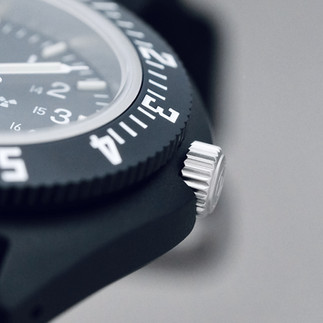
The case of the CeraShell® Navigator Quartz seems to have indeed been left untouched since the steel automatic version I reviewed a while back, however Marathon made a few minute modifications to make it better. First, the bezel was slightly widened and the ultra-grippy knurling of its edges sur-elevated from the mid-case to make it easier to grip and turn in either direction. (So that pilots using gloves or manipulating the watch with cold fingers can operate it without any issue.) This in turns makes the ensemble appear more purpose-driven and further ready-for-action than its steel sibling was, which visually translates to a beefier appearance which I find to be oh so attractive. Conversely, the lugs were tapered down more intensely to slim down the case’s profile and improve wearing comfort, which is supreme here given the 53 grams of the CeraShell® Navigator and the thinness of the nylon strap. Iconically, the right side of the case flares out to form natural crown-guards and stabilize the watch onto one’s wrist.





The Heart of the Matter
I didn’t buy, or cared to buy, a Swatch x Omega MoonSwatch, or even a Swatch x Blancpain Scuba Fifty Fathoms, and less so a Swatch x Audermars Piguet Pop, for they all come across to me as being the fruit of quick-cash-grab schemes which explain the way they were marketed and how and what they are made of. We can all celebrate a brand’s pursuit to innovate to make better watches for smaller amounts of money, but that is clearly not what Swatch and its acolytes were in for. If they were, they would have spec’ed out these watches differently and put more attention to pair the bioceramic cases with better components to make them actual daily wearers, and not, as I understand it, made out of mass-produced parts assembled into watches by machines and QC’ed by them. (And of course they’d have appealed to the enthusiast community and not to the entire world and universe.) Marathon obviously isn’t in the business of making everyday watches but tough military tool watches for professionals, which us simple civilians can also benefit from and proudly wear.

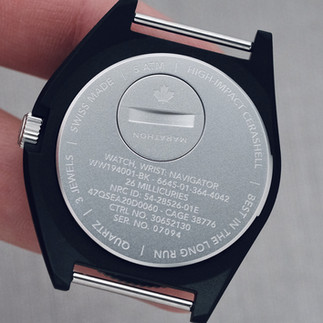
This is why the Canadian brand came up with its own recipe for a bioceramic case made of bio-sourced plastic and ceramic powder, albeit not a novelty in the watch world, but one for tool watches, which it combined with a sapphire crystal, a high-torque and ultra-precise quartz caliber (whose battery can be replaced by us mere mortals by way of a convenient battery-hatch located on the case-back,) and its legendary self-illuminating tritium gas tubes. For all of this, Marathon will only ask $550 USD which is to me a small price to pay for such a capable tool watch, whether it were to be used on deployment in a far-flung country or in your backyard to mow the lawn or BBQ some steak. In other words, Marathon debuted by making robust watches for those who needed them, as it still does today, and now gives us all the opportunity to wear a good tool watch for whatever we bring to our lives.

Conclusion
At the end of the day, you read this review (for which I thank you!) because you were curious to learn about the new Marathon CeraShell® Navigator Quartz, what it is, what it can do for you, and for how much, for you are looking to add another quality utilitarian timekeeping device to your ever-growing collection. And that is what the new CeraShell® is to me and could be for you, at again the meager price of $550 USD which makes it the most affordable Navigator in Marathon’s catalog today which is quite neat and insane to think about at the same time. Lastly, this model also comes in a date version for an extra $40 USD.
Thanks for reading.


