
Marathon OSAR-D 36mm
Smaller Doesn’t Mean Weaker
July 29, 2026
by Vincent Deschamps
What is the point of reviewing the same model twice in two sizes? Because the size difference creates two different watches. At least it does if both versions are strapped to the same wrist and thus become two whole separate stories for they actually create two sets of emotions for the wearer. But you know this well: we watch enthusiasts and collectors derive immense pleasure arguing about watch dimensions, as in we all have our own opinions on the subject (and personal preferences since we are all different) but there are people who unitarily declare—regardless of anyone’s wrist circumference—that XXmm in diameter is the proper one for dive watches, YYmm for field watches, and ZZmm for GMTs. And so on and ad nauseam. As if we all had to agree with these statements especially if they are formulated by self-appointed watch experts. And the negative commentaries they attribute to smaller watches, primarily tool watches, pertains to their feminine aspect, their non-professional nature, and even child-like attributes.
Real men wear big divers after all. Roar.
I know how silly this may sound like in 2026, however we are all still hearing these words being said about petite utilitarian timekeeping devices even if we wish we didn’t. Because idiots and bigots are everywhere and definitely occupy a prime seat in the watch community. (Perhaps not outright in public but certainly so in private conversations.) The truth is that we are all a bit on a spectrum when it comes to watch dimensions as we all have the capacity to wear smaller and larger ones, and what we lean towards each morning can change each day. We have moods, we have special desires, and unique goals we need to meet today wearing our preferred diver. And the reasons why we may opt for the smaller over the larger one may have to do with on-wrist comfort, how legible it is regardless of its size, or simply because it best matches who we are. This is all of what we’re going to discuss today looking at the Marathon OSAR-D in 36mm, by far the smallest toughest most legible dive watch I’ve encountered thus far.
By the way, you can read about its 41mm sibling here.

Specifications
The technical specifications of all Marathon OSAR-D models are extreme and the same regardless of their dimensions, save for, of course, how much real estate they are going to occupy on your wrist. Something you would know should you already be familiar with the historical Canadian brand, for it specializes in ultra-tough, superlatively legible, and over-spec’ed military and professional-oriented tool watches and it has been doing so since the early days of World War II. I’ve reviewed a few of its models on Mainspring before, including the above-linked 41mm OSAR-D, the SSNAV Steel Navigator Auto, the 36mm Officer’s Mechanical, and more recently the CeraShell® Navigator Quartz. They are all nasty. And I for one I like to write about several models from the same brand to observe the evolution of its designs over the years, or the improvement of the technical endowments of its timepieces, or witness how it revisits older designs to bring them up-to-snuff with the modern world. Marathon, however, is extremely consistent.

The design of some of its models doesn’t seem to have changed one iota in the past few decades and that is something that ought to be celebrated. (For it shows commitment to a particular blend of tool watches some of us strongly gravitate towards and always want to have access to.) Marathon’s expansive catalog of beefy dive watches for example showcases the same design for the steel bodies, the same layout for the dials, and the same CNC-machined patterns for the ultra-knurled crowns and bezels. They are still here after years of being in production because they work and demarcate Marathon from a shit load of other tool watch-oriented brands. And many of its models are big and heavy, which is alright because we might think that professional-grade or tough tool watches ought to come with certain dimensions and meat to be professional or tough. In many instances it is true. In others, it isn’t. You see, from the OSAR-D in 36mm emanates stronger badass vibes that were generated by its 41mm sibling which surprised me.
And I would say this: it is 100% Marathon in all aspects of its design and specifications. Just smaller.

Because there is something special about wearing a 36mm diver in 2026, even though this was a common diameter for many professional divers back when men were more confident and more comfortable with their own masculinity and women thought that was the right size for such a timekeeping device. However this smaller diver is special. Sized to my 6.50”/16.5cm wrist, the OSAR-D in 36mm weighs 134g and clocks in at 43.5mm lug-to-lug, 13mm thick, and comes with an 18mm lug width. I’m pretty sure that this is the heaviest smaller diver I’ve ever gotten hands-on and the weight does play a role in thinking that the OSAR-D is tough-as-nails, for it always feels to be so when looking at how each part and square micron of the case and dials were assembled and manufactured. As well as how it carries itself on the wrist. There might be a place and time in any collector’s journey for larger professional-grade dive watches but today is the moment when I invite you to consider that a 36mm underwater exploration tool watch could be for you.

In other words, from a technical standpoint, smaller doesn’t mean weaker. For Marathon did literally preserve the 41mm OSAR-D technical specifications to make the 36mm as capable as its larger sibling. For example, inside the perfect case ticks a Sellita SW200-1 caliber (4Hz/41 hours of power reserve) which is now a bit of an old-school Swiss movement according to self-appointed watch experts but one that works really well. It is sandwiched between the dial and a screw-down case-back, together with the 5.4mm screw-down endowing the 36mm OSAR-D with an impressive 300 meters of water resistance. Above the dial we find a flat piece of sapphire crystal equipped with a date magnifier, and below it thickly applied layers of MaraGlo, Marathon’s proprietary lume blend, on the hands and applied markers which is this collection’s most unique feature. (I recommend reading the review of the 41mm version to learn about the history of this diver.) We also find the brand’s Monster Truck-like bezel knurling and 120 crisp bezel clicks.

Design
I know that I’m rambling more than usual in this review and perhaps struggling to make some kind of point. This is mostly due to the rarity of the OSAR-D 36mm dimensions (in relations to its aggressive and ultra-purpose-military-driven-look) which I’ve never encountered before in a modern divers*. In other words, the smaller format of this model does indeed generate different and stronger emotions than the 41mm version did, especially because it is the successor to a 2000’s Search-and-Rescue model which was evidently tough and ultra legible. There’s heritage. So experiencing such a distinct small dive watch isn’t something I’m used to, and you probably aren’t either, and thus formulating interesting thoughts doesn’t roll off my brain as easily as it normally does. However, I’ve been hoping that any microbrand would dare making a good dive watch in this diameter (and I have made appeals to a few of them) but most brands I know of wouldn’t dare doing so because it is, I presume, not what people are looking for and unmarketable.
*Just imagine if Omega squeezed a Ploproff into a sub-40mm format! That’s how novel it feels.

But there are folks out there looking for smaller dive watches either because they find them better suited for their wrists from a dimension standpoint, or because they make more sense from a legibility point of view—in the same way a 34mm Benrus DTU-2A/P does for a field watch—or for they are looking to experience something radically different in horology. So if we put together all of the Marathon’s OSAR-D 36mm specifications and design, which is again the same as its 41mm larger sibling, we find ourselves with a rare specimen. What Marathon did well was to preserve but resize the case design and dial layout to make it work into a smaller chassis, as the hands and applied hour markers are closer to one another albeit remain extremely legible, the date aperture had to be large enough to function well with the sapphire-mounted magnifier, and the bezel inlay further narrowed down to preserve the watch’s overall dimensions. This is one of the rare cases where I do appreciate seeing all dial furniture squished in a little bit.


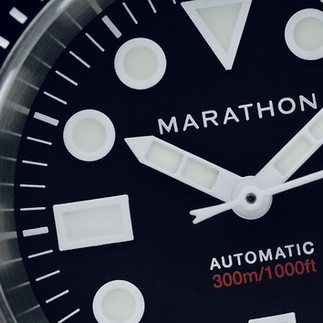

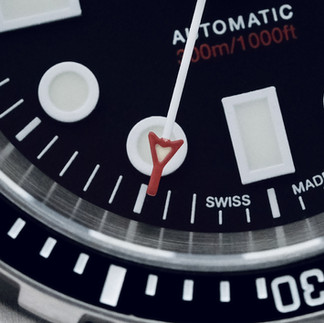


From a general design standpoint, the OSAR-D 36mm resembles a mean little machine that can take a beating and is even asking for one. Even though all visual elements were reduced compared to the 41mm version, and thus creating less blank space on the dial which I do appreciate, the whole ensemble therefore feels more purposeful and ready for action, as it is as easy to read the time on the 36mm version of the OSAR-D as it was on the larger one, which is impressive for it shows that Marathon’s 2000s Search-and-Rescue designs were effective and timeless. The time is actually easier to read in this format as the smaller dial + smaller hands and markers combo more quickly enter my field of vision as a cohesive ensemble. What does make the OSAR-D stand out from all other SAR models from the Canadian brand, is the switch to a more conventional diver dial layout showcasing markers shaped in batons, circles, and inverted triangle at the twelve, a date at the three, and pencil-style shaped hands showing a multipartite construction.


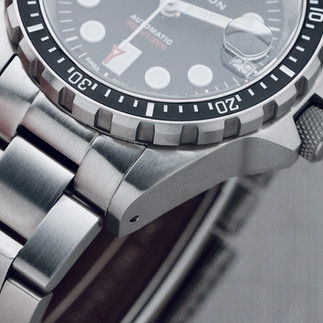
In other words, the OSAR-D design language feels more modern than other SARs from Marathon and it looks darn pretty good in a 36mm format.

The Heart of the Matter
The appeal of Marathon’s Original Search and Rescue Date (OSAR-D) in 36mm thus is not simply the downsizing of this model from 41mm and 46mm diameters (the other sizes Marathon’s offers all of its SAR divers in,) but the fact that the Canadian brand understands that there are enthusiasts, collectors, and professionals out there looking for smaller robust divers because that is the size that best suits their wrists. Buyers are not intimidated by their smaller physical format as they know that, by buying from Marathon, they will get a fully-fledged tool watch which comes with all the bells and whistles professional divers ought to have. So having a well spec’ed out and solid timepiece is something guaranteed, and it would probably never cross their mind that they are compromising in any of these areas by going smaller. More importantly, Marathon is not a microbrand which can afford to play with novel ideas—because they have a heritage and legacy they have to uphold—and be alright if what they come up with doesn’t stick with the enthusiasts and collectors communities.

Instead, Marathon has a reputation they have to preserve and certain obligations they must fulfill. In other words, the brand didn’t create a 36mm version of the OSAR-D just to please anyone in particular, or to follow a trend, or to be in favor of social media’s algorithm, or claim they are the brand that can do small and mean and step on the top spot on the podium in this unknown race. But rather—and simply so—to make one of its core collections available in a third format because that is what some folks need and are looking for. In all the years I’ve met with the Marathon team at watch shows, they have never pointed out to their smaller, lady-friend tool watches with greater fervour than they did other versions. But instead presented the whole range as coming in three sizes. Akin to shopping for a Land Rover Defender and having to decide between the 90, 110, and 130 chassis which give less, more, and much more room inside. Thus, there is nothing unfeminine, unprofessional, or child-like about a 36mm military/professional dive watch and this one proves it.

Conclusion
Phew, that was another long one and I do hope that something remotely interesting came out of it. At the end of the day, the Marathon Original Search and Rescue Date (OSAR-D) in 36mm is a formidable tool watch I would feel confident taking on all sorts of adventures, near and far, smooth and intense, knowing that this small SOB of a dive watch can handle it all. By the way, I reviewed the black version of the OSAR-D 36mm but Marathon also makes it in a white dial, and I paired it with the brand’s three-link stainless steel bracelet which comes with double-screwed links, beefy spring-bars, a double-pusher deployant clasp complete with a safety latch, diver’s extension, as well as five holes of old-school micro-adjustments which will set you back $1,600 USD. I was also tempted by the rubber version that comes with Marathon’s 3-piece kit for $1,300 USD. Both are excellent options.
Thanks for reading.


